May 5 2017

Video tour taken today, in 30-60 second segments. But, the site is having difficulties and I can’t upload them to the site. Next time, we’ll have to go with pix today.

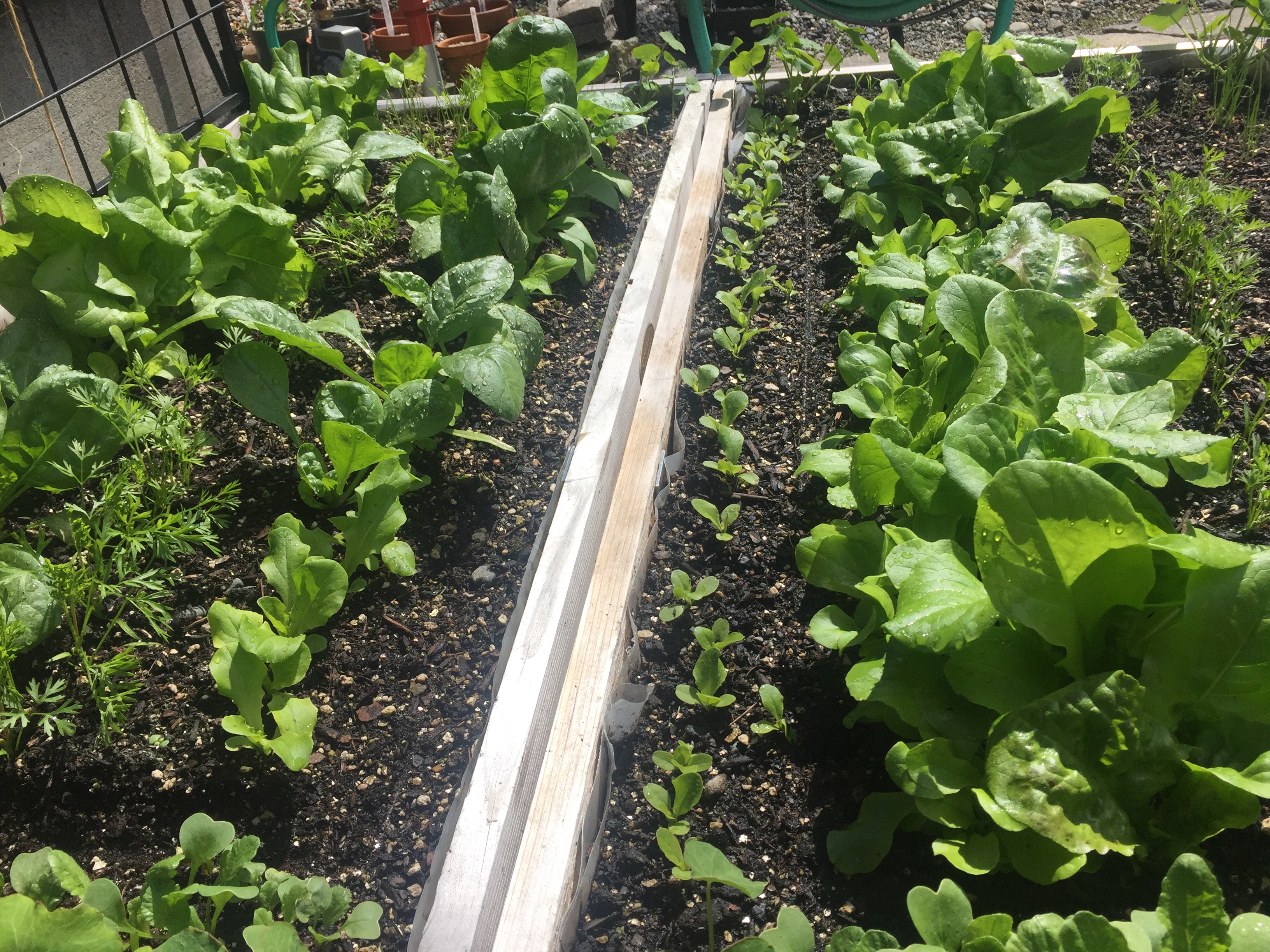
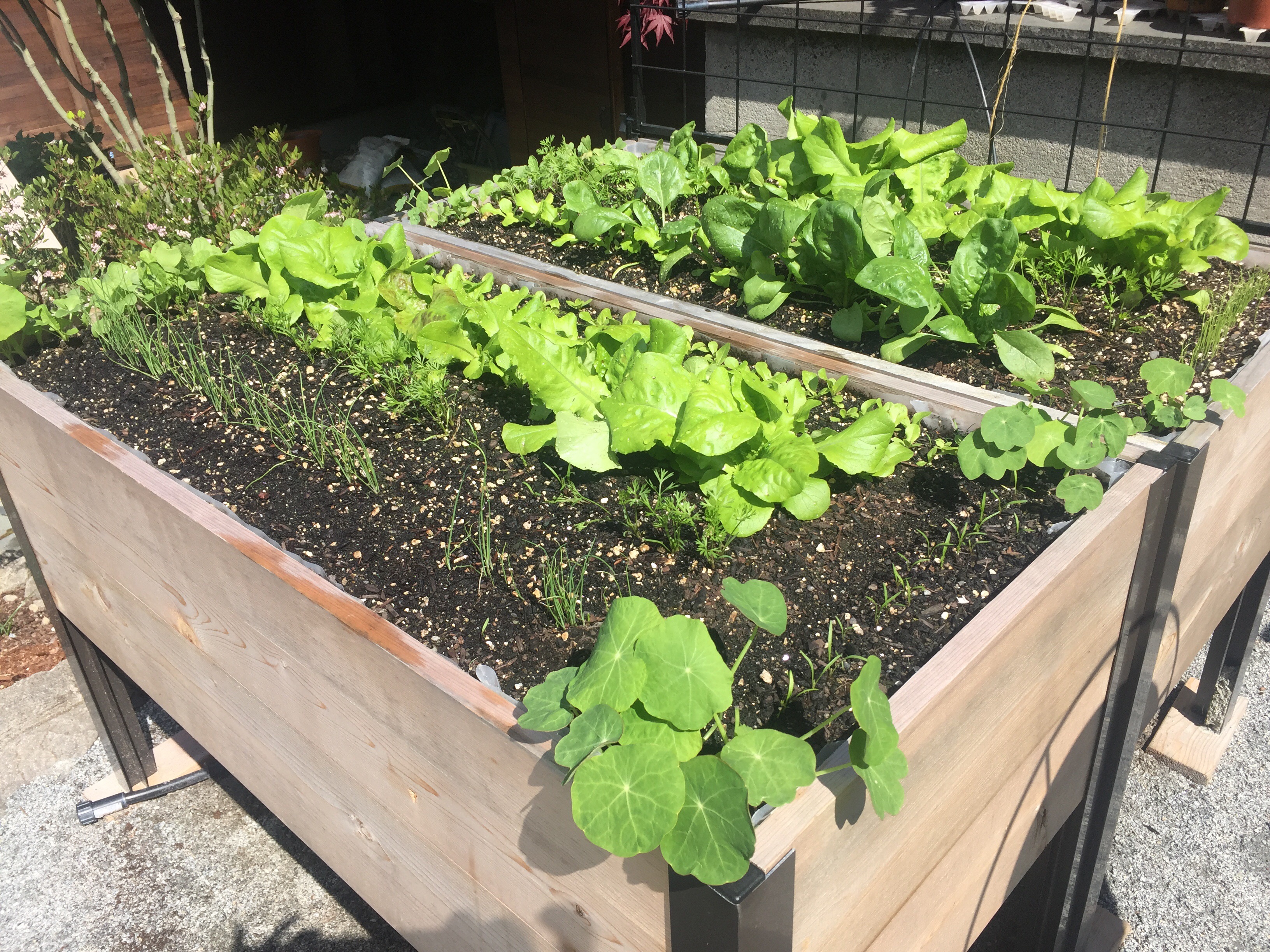
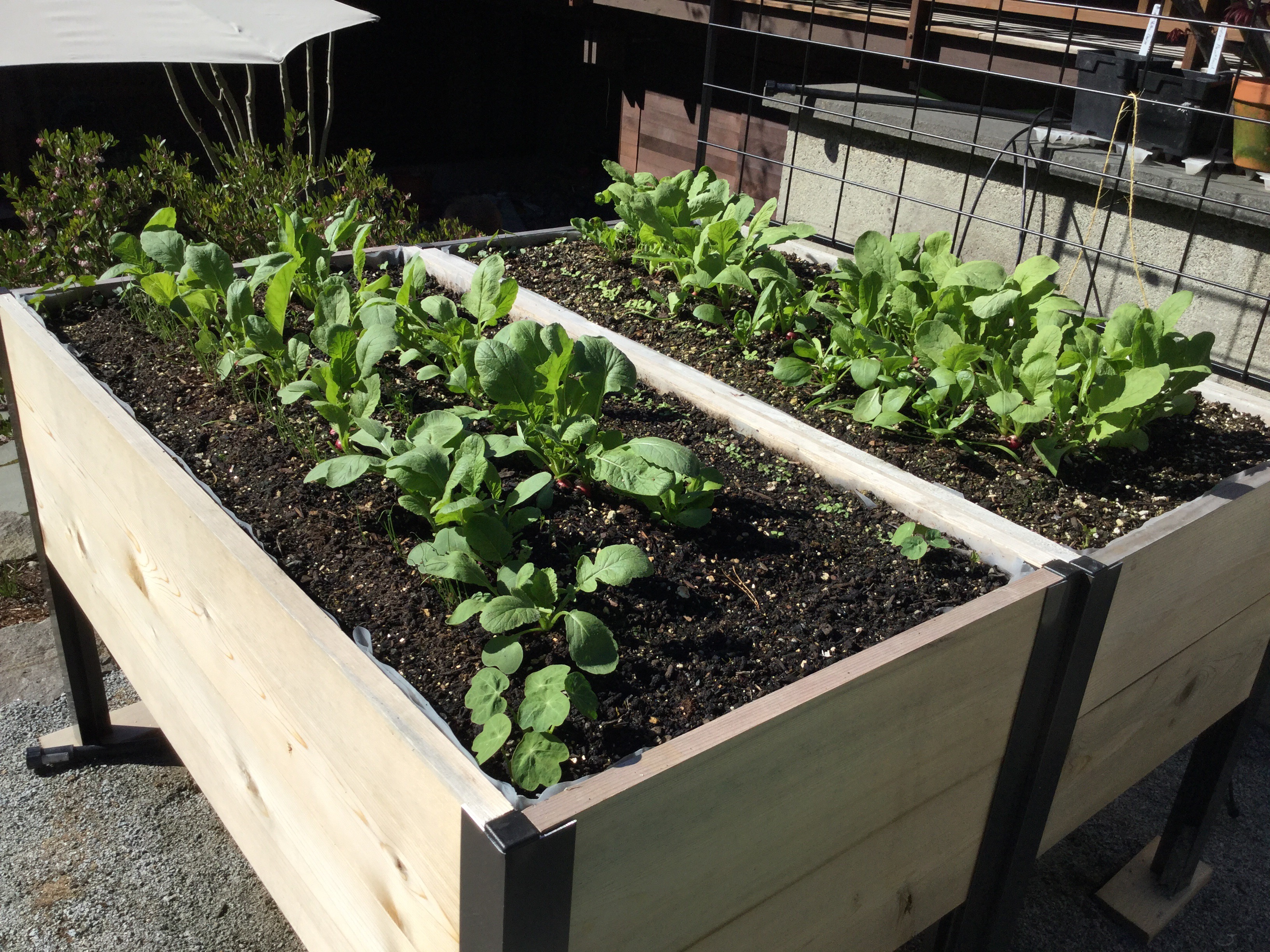
We had salad from our veggie garden last night. To harvest baby spinach and butter lettuce, you can cut the largest leaves off as they grow, and then more leaves grow in. It also allows more light for the carrots and onions (scallions), which I need to plant differently next time. It produced enough salad for three already- we planted it March 26. The carrots, green onions and new set of radishes and lettuce still need to mature. I planted pole beans and cucumber along the back of the planters on May 1(4 days ago), to trail up the trellis. The cuke seeds turned out to be a “bush” variety, which trails over things rather than climbing (gotta read the fine print…who knew about that?). I can still use the trellis to loop the vines up before they hang back down,as long as the beans have some room to climb. What with the nasturtiums in most corners and the newest veggies along the sides, this is going to be one full, busy planter!

Today had a handful of nasturtium leaves, they taste peppery good (a sulfur compound, similar to radishes).

This is after harvesting all the first batch of radishes and the larger leaves of baby spinach and butter lettuce: more light for the rest

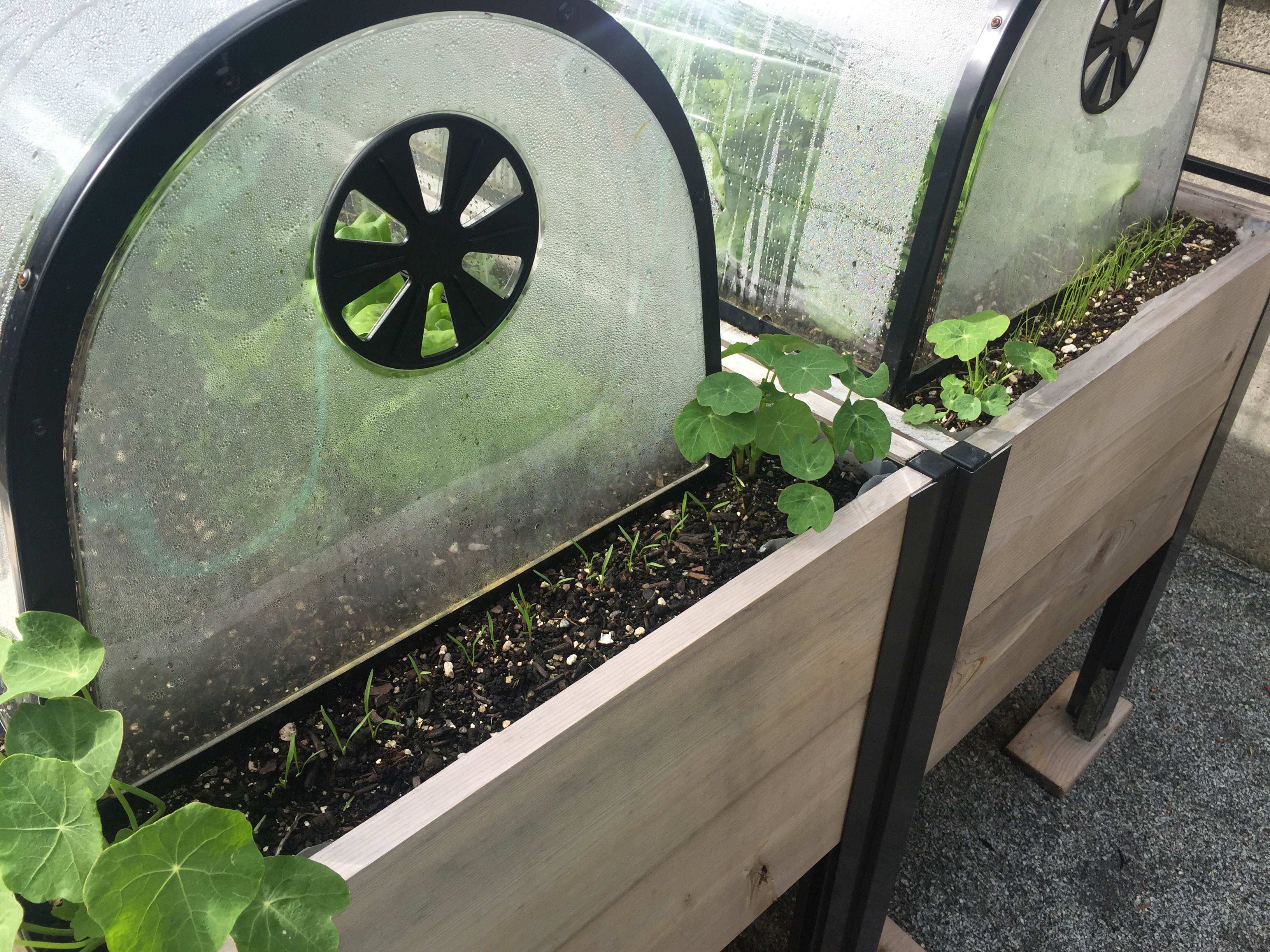
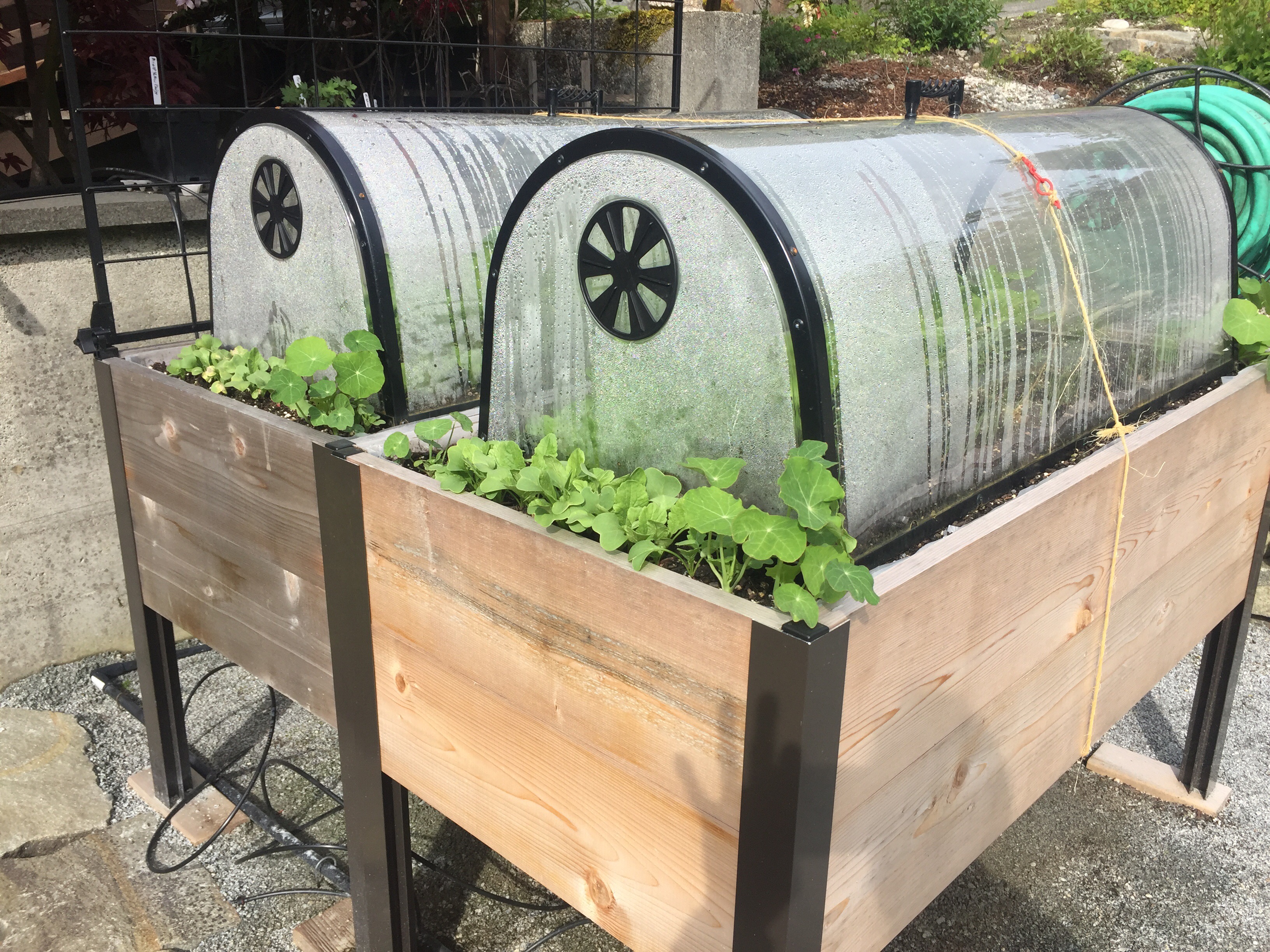
View of what the cloches cover…I planted outside with stuff the deer probably won’t eat, like nasturtiums and onions. Hopefully they don’t like cucumbers?!

Earth day (tomorrow)/ April 21

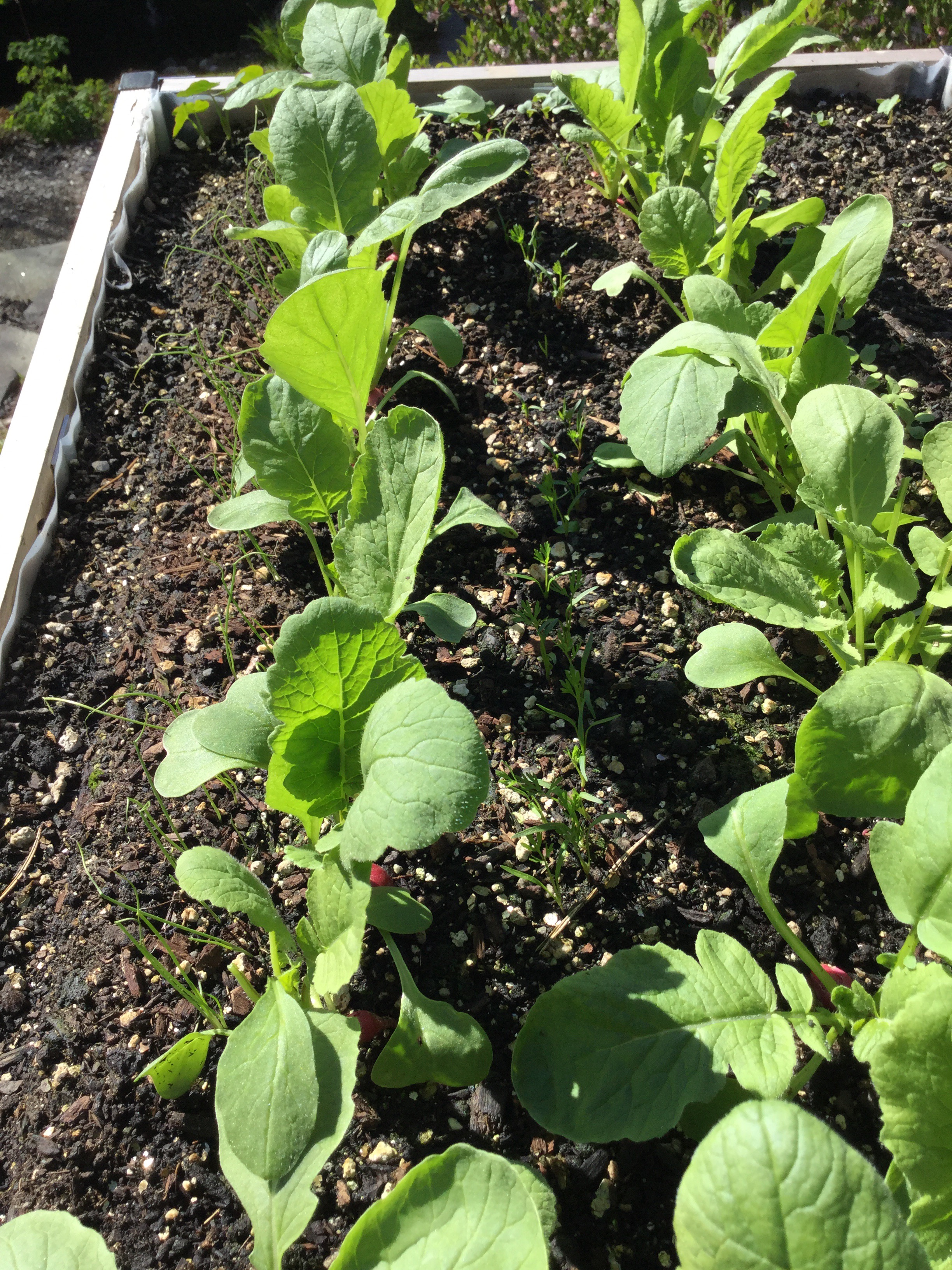
Below is the vegetable garden as it looks today, almost four weeks after sowing it and putting cloches on. I’m leaving them off all day today due to the beautiful 60 degree sunny weather we’re having…..tomorrow there will be the start of several days of rain. (This is the Pacific Northwest, after all, and a historical record year of rainfall – for the winter and for each month so far including April, 44 inches or so as of a few days ago. This tops last years record rains apparently). We’ve harvested about 30 radishes so far in the last few days, to eat and also to thin out clumped areas. They are really good straight- peppery with just a dash of salt and a beer. There are still a lot of radishes left. They were supposed to be just planted in between the other ‘crops’ to make use of all the garden area. But they opened and matured first with rapidly enlarging leaves, and if unchecked they would choke out the others.  They taste great, but they make a good weed. **So, as a cautionary tale, I would suggest to myself as well as to you, that because of all the large leaves, next time the radishes should be planted in several adjacent rows towards the ‘back’, or north side of the planters***.  Skinny leaved Onions are the best at the southern front rows, followed by carrots and spinach. 

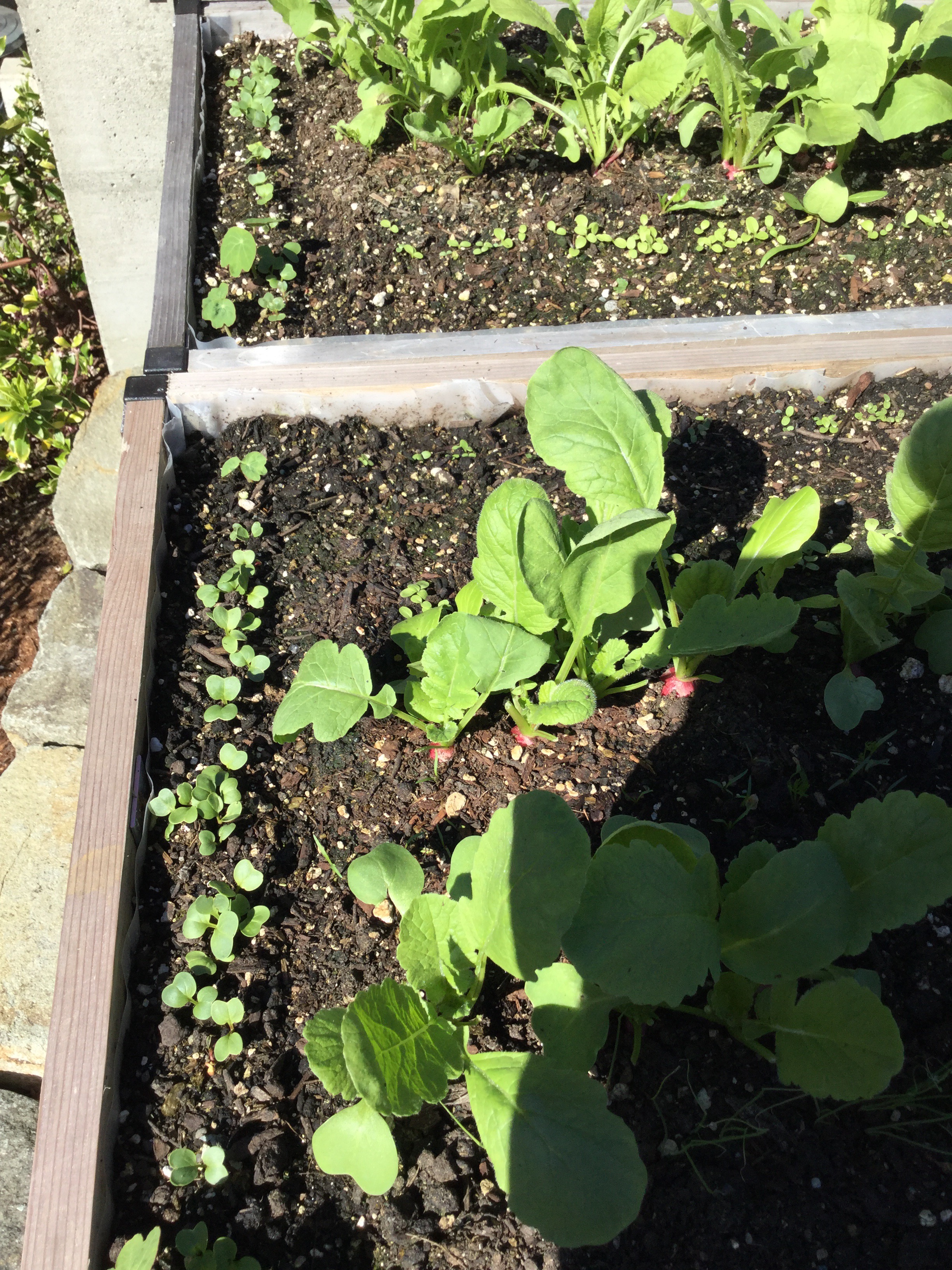
As the reddening lower root enlarges, the radish pushes up above ground, so you can see which ones are ready to pick.  These were mostly picked early, though, since they were shadowing out the other veggies.  I had put some more radish seeds outside the cloche along the west border, which are now germinating, to use ALL the space, and some more carrots and onions outside along the east border……probably should have switched that, given how aggressive the radishes are compared to the others….the others aren’t up yet.

I do have red/yellow/orange medley nasturtiums, those are the leaves coming up (to cascade) from most of the corners. I left the whole north border clear, for future planting of  the climbing plants- pole beans and cucumbers, and maybe snow peas. That should be soon. 

New radishes left, older radishes and onion, carrot and spinach seedlings
The larger radishes planted “in between” the onions (to left) carrots (middle), and lettuce (right)

Everything’s coming up….natives! April 14

Pretty much most things need to be poking up by now or they’re not going to….except a few things like tiger and leopard lillies. It looks like all the plants I transplanted, propagated or bought last year have made it through the winter. This includes a couple of pretty Fools Huckleberrys, making a total of four. And our real native High Cranberry, the Vibernum Edule.  We had to take several non-native ones out that someone had sold us years ago, replaced them with another few which also turned out to be non native. We FINALLY ( we think) have determined through exhaustive research of the flowers, found the real thing, we bought ONE.

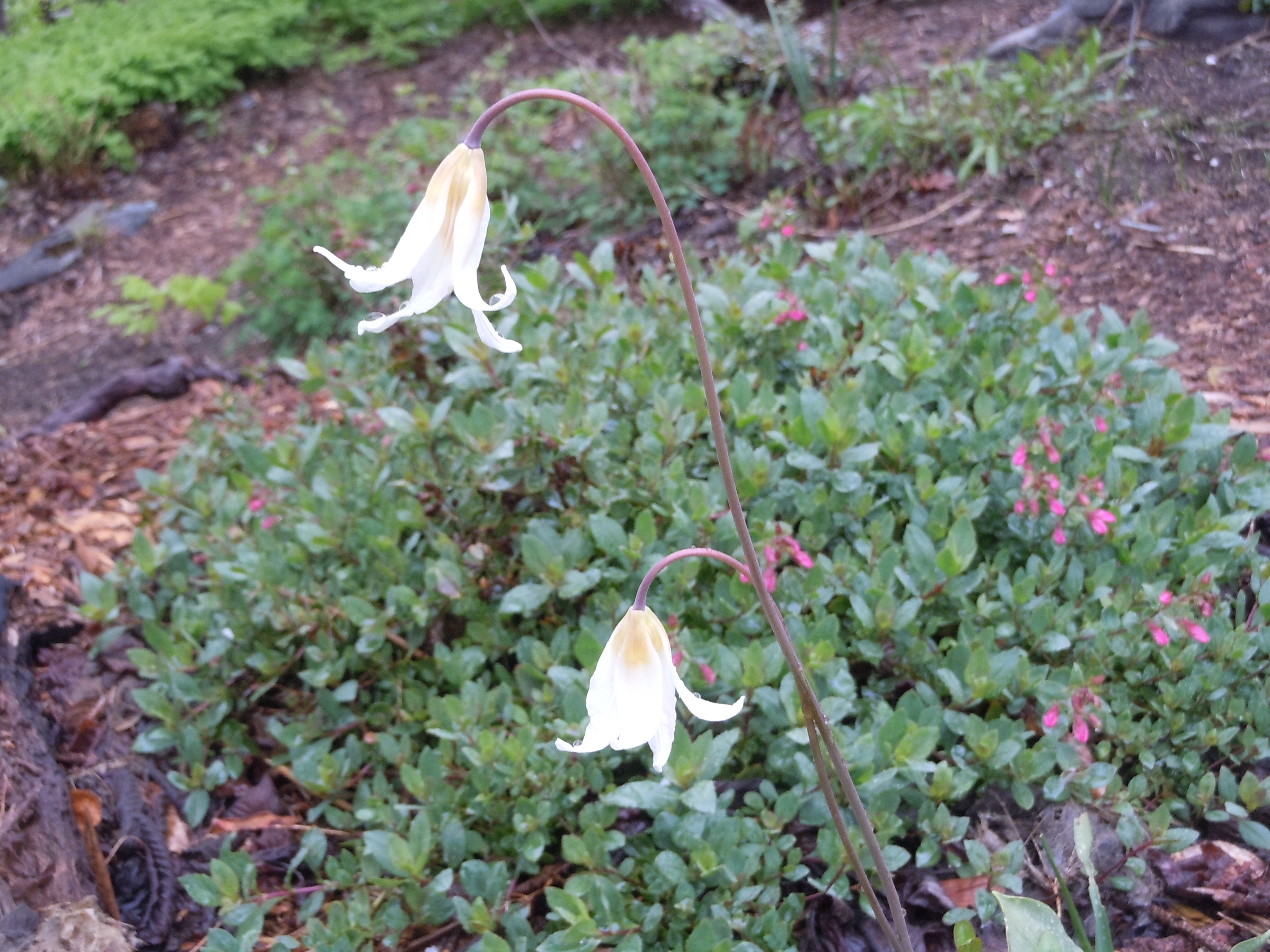
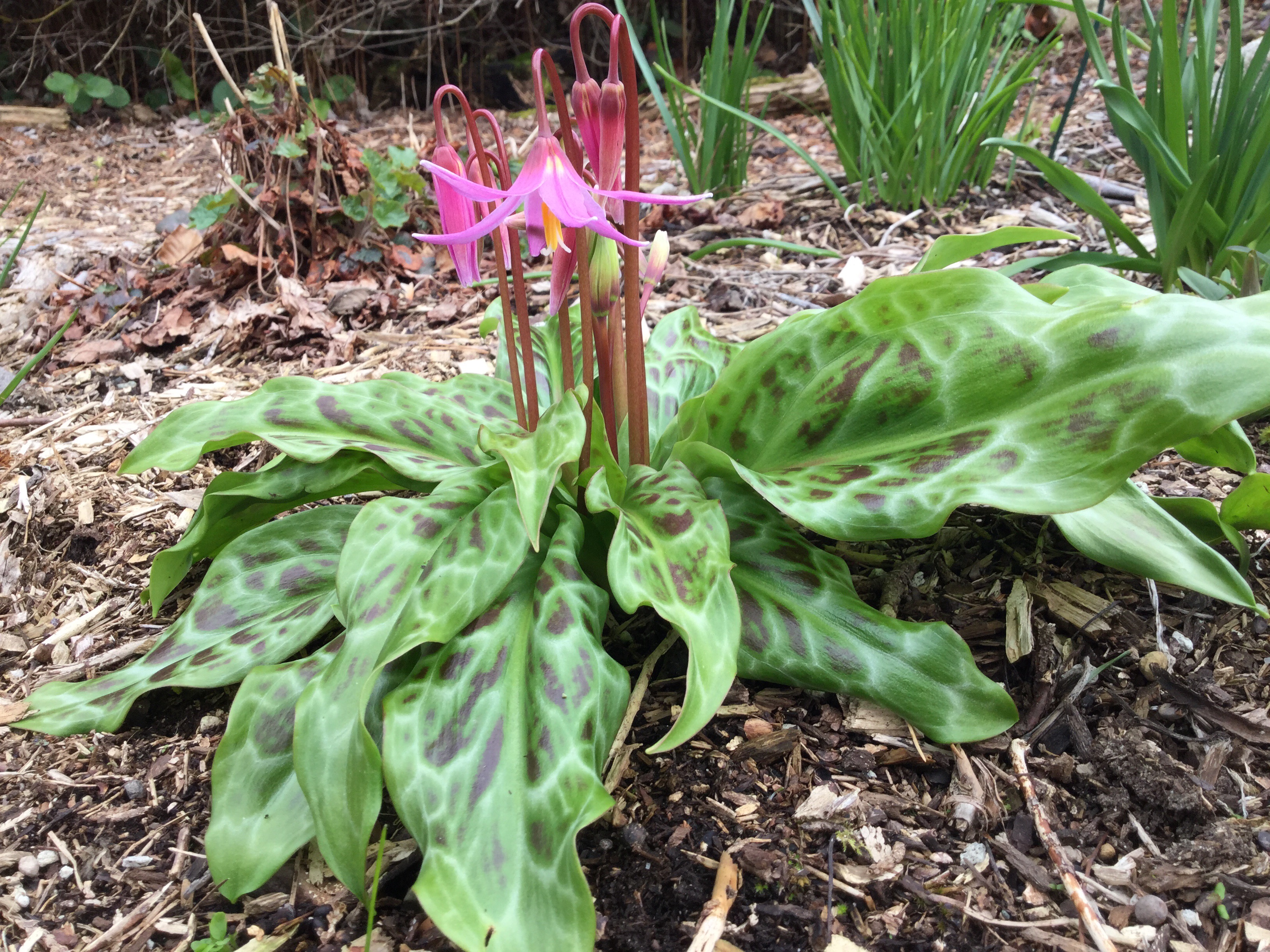
 I have many, many fawn lillies around now, though most are still young and only leaves, in a couple of years it will be quite pretty, meadow-like. Most of these I have propagated from seed, but some are mid-range age and should bloom soon.  I don’t know if any of them will be pink, since I mixed the seeds together with the white and off white ones, but so far none of the pink seeds that I planted in a pot have come up. Though, the pink plants that I do have are vigorous and one has now produced quite a bunch, oh, and a whole lot o’ trilliums, too.

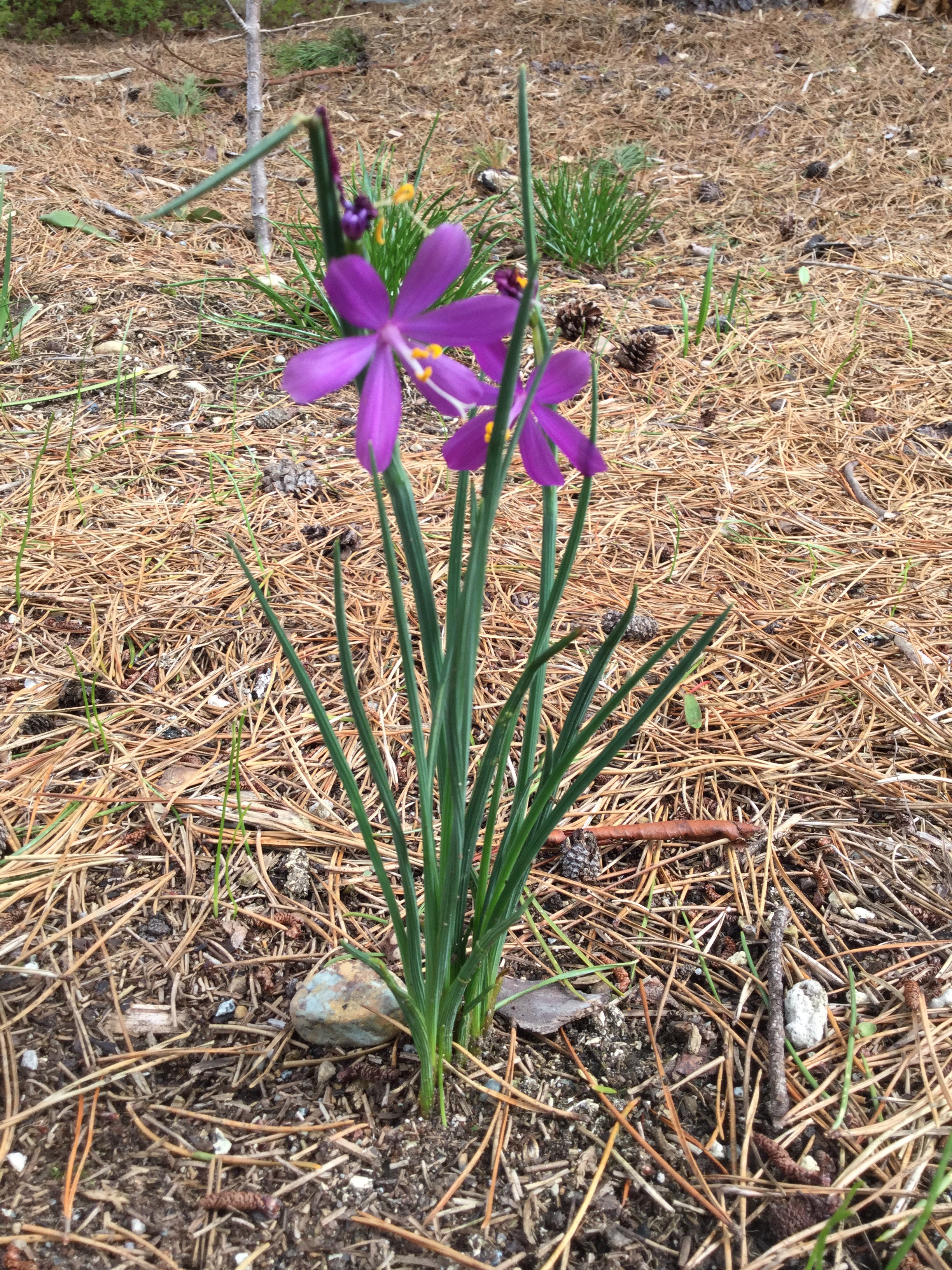
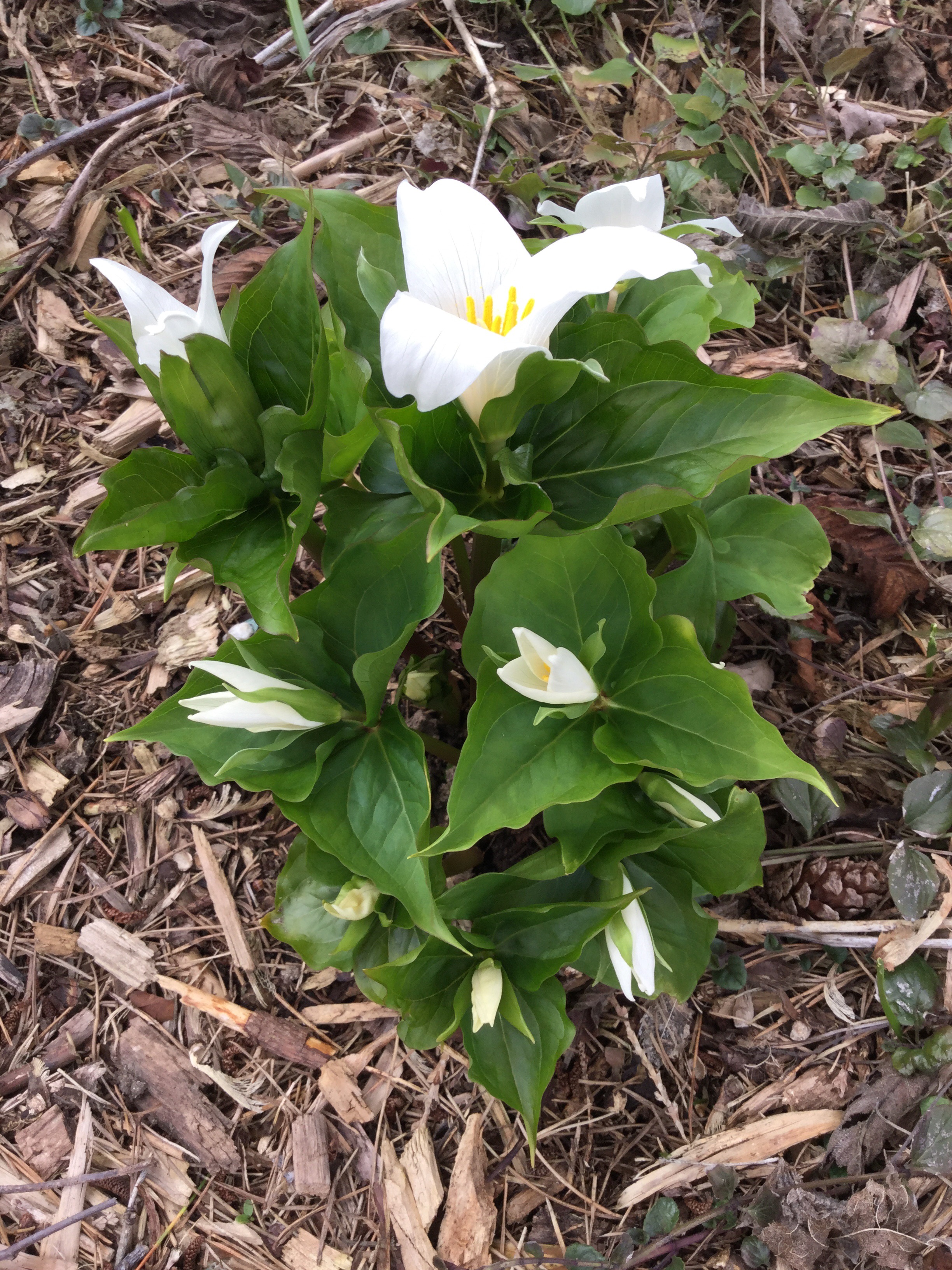
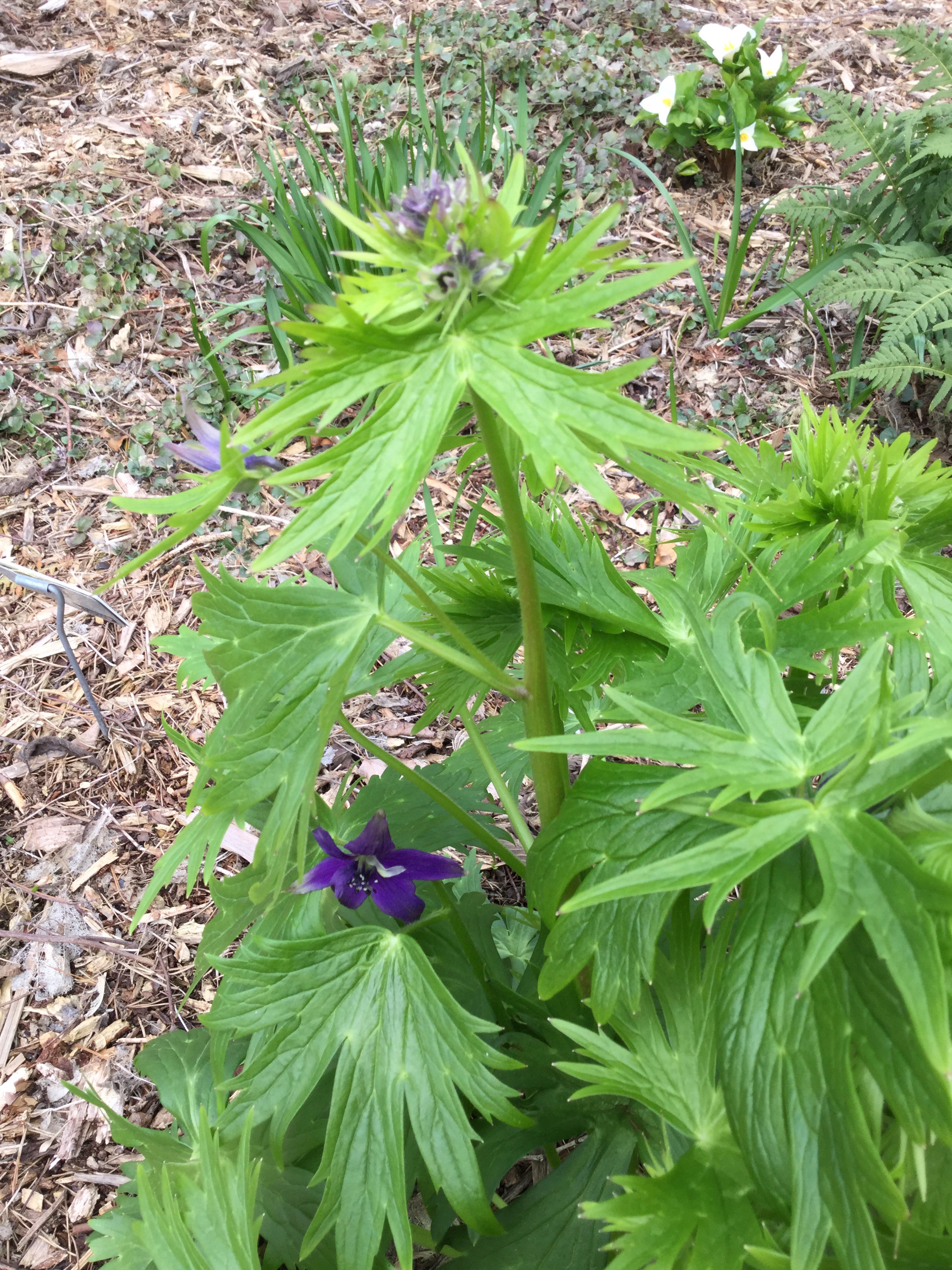
Now blooming: trilliums, Fawn lillies, Silk flower, Darba Incerta, Monks hood and some of the Blue eyed Mary in planters. ABOUT to bloom?: Chocolate Lilly,  some Penstemons, Pussy toes, some Bear Grasses and some more fawn lilies.

Too early for the flowers of Columbines, Lupines, asters, irises, and for the sunflowers: Mules ears,  Arrow leafs, and Gaillardia, though the leaves are coming up. 

Huckleberries…..we replenished our supply of deciduous last year. I don’t think all the ones we had were planted in good areas, except for the two thriving red huckleberries. Some plants were lost to hot dry weather or just never thrived, and these survivors I transplanted to better places this spring (plant rehab). I’d  forgotten that id bought two groundcover  Vaccinium Membranaceums last year, so now we have three of those part shade plants, and two more sun loving ground cover Vaccinium Deliciosums for the front yard. These are all good black huckleberries. We added three taller Vaccinium Parviflorum (upright red huckleberry) to the lower back yard so we have six total now. We also also have an older Vaccinium Ovalifoium which is upright/deciduous/black huckleberry, which I transplanted and it is in rehab. In addition to the deciduous, there are a bunch of evergreen huckleberries, in various stages of health and size….some have been crowded or shaded but they are part of the bird-scape and provide winter forage.

Deer in the house

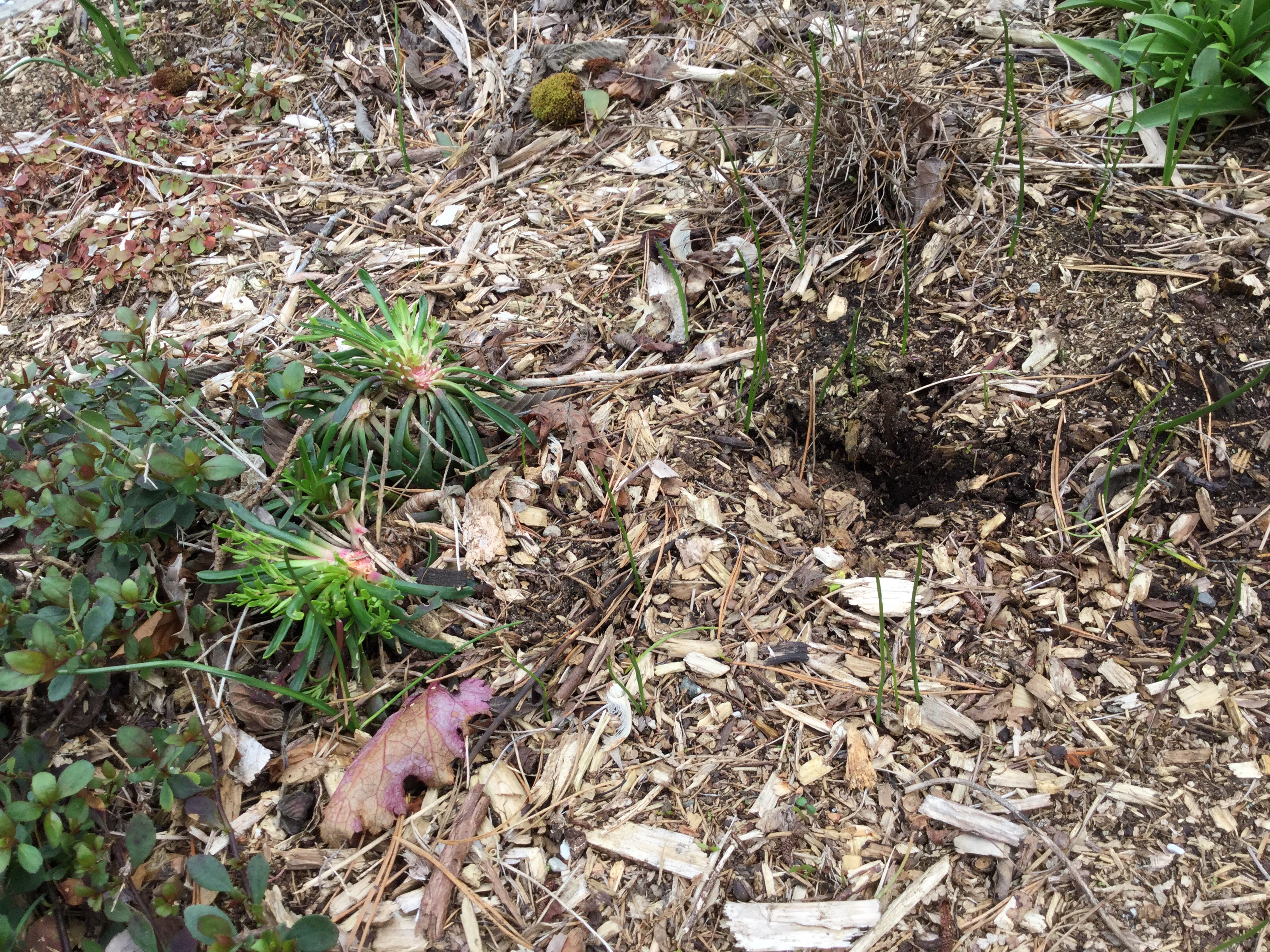
Telltale hoof prints, and gnawed Lewisia Columbiana.  We haven’t had a deer here since we moved in 22 years ago, and now we’ve had them twice in eight months.  The rest of our plants blooming right now are flowers the deer apparently DOESNT like:

Deer hoof print to the right

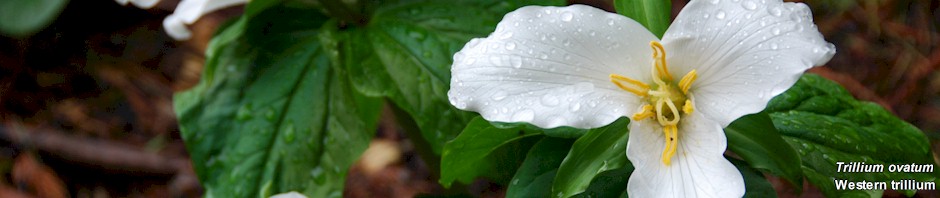
Below: Pink Fawn Lilly, Silk Flower, Trillium Ovatum, and Monks Hood (poisonous). These are all pictures from couple of days ago:

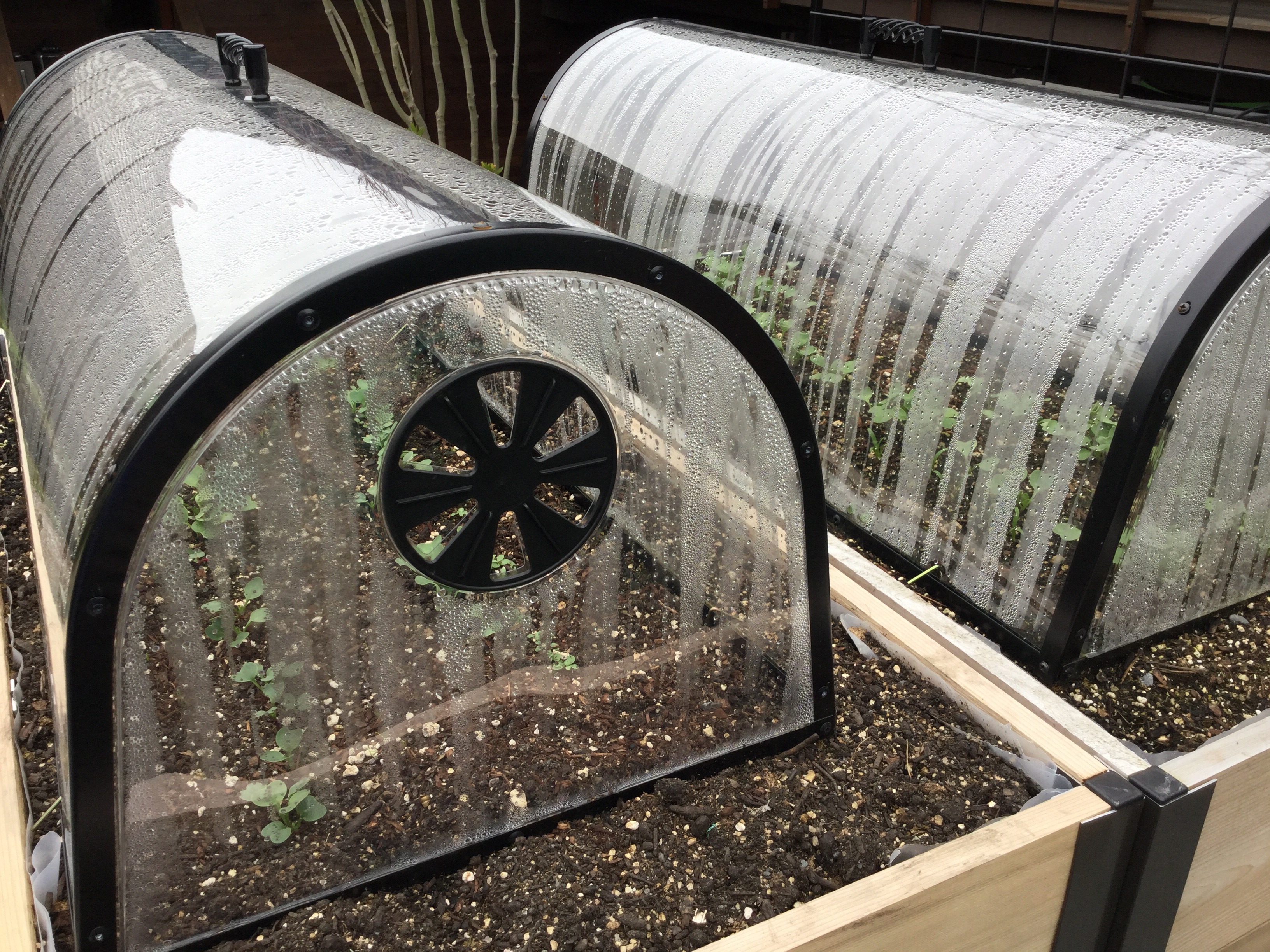
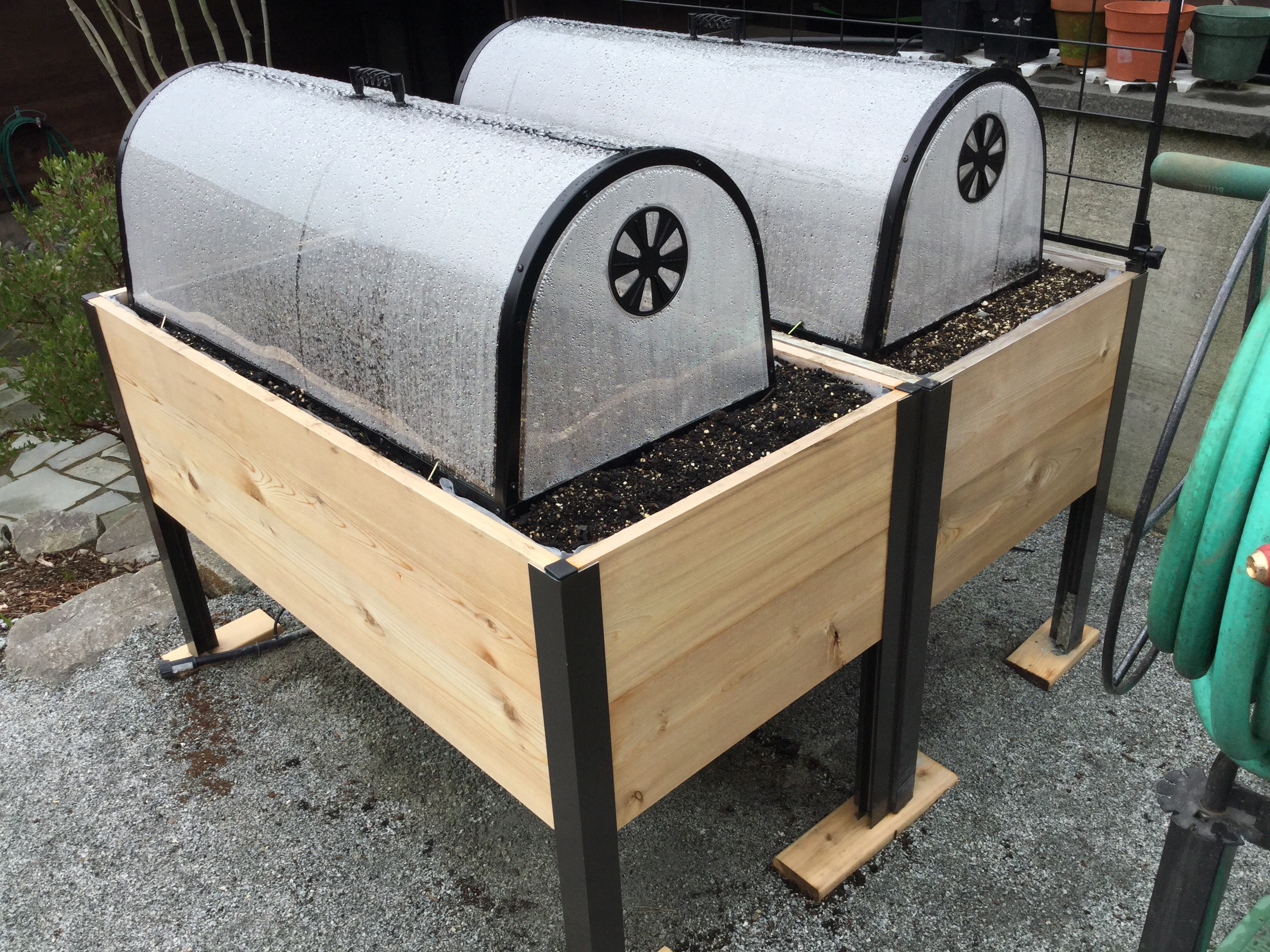
Oh, and I almost forgot, an updated picture of the hothouse, as I’m calling my raised planter now. I measured the temperature during sunny time. 55 in shade, 65 or so in sun, and 80 in the hothouse!! No wonder they like it so much. I may have to remove the cover during the warmer days, but I’m worried about DEER EATING MY VEGGIES!, so I’ll just take them off during the hottest hours of the day.

Rest of the crew….


Spinach and carrot seeds popped up at 8 days, and the ‘bunching’ onions or green onions on the 10th day.  The spinach is a “baby spinach” which is a type that has individual rounded leaves, not bunches (not “baby” at all!), and the seedlings look linear/branching, not rounded seed leaves like the lettuce. Looks like I’ll have to mark my rows better for seeds; it is true that once you’ve covered over the seeds with soil, it’s pretty hard to tell where the original line was. So the radish lines cross the spinach line and some lettuce, so what? They are loving having the cloche to keep them cozy warm like a hot house, and the radish leaves are huge already and it’s only April 3. Makes me tempted to start the cucumbers early inside the cloche,  yet I don’t think they like the transplanting needed to give them access to the trellis….technical issue I’ll have to address.

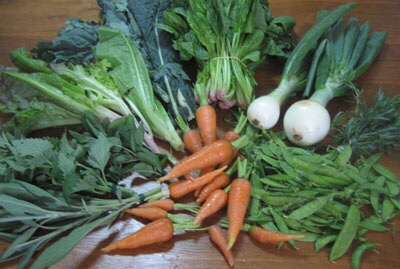
Full disclosure, this is not my cornucopia below. We started our garden way too late last year for much of anything, since we didn’t have the planter bed until end of May. But we are planting all of these things this year(see prior march posts), except green onions instead of leeks:

Veggie garden for the Pacific Northwest ! 

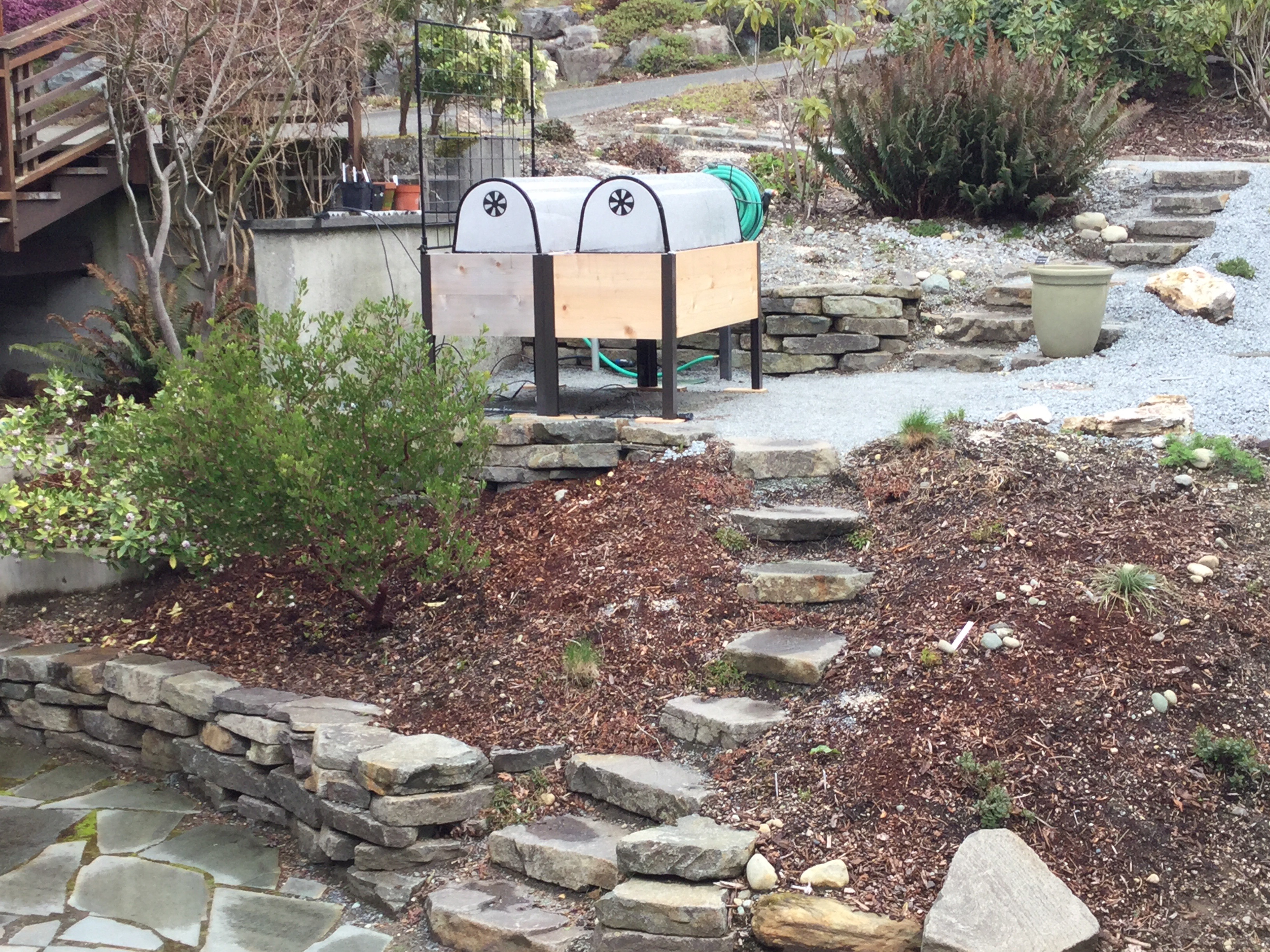
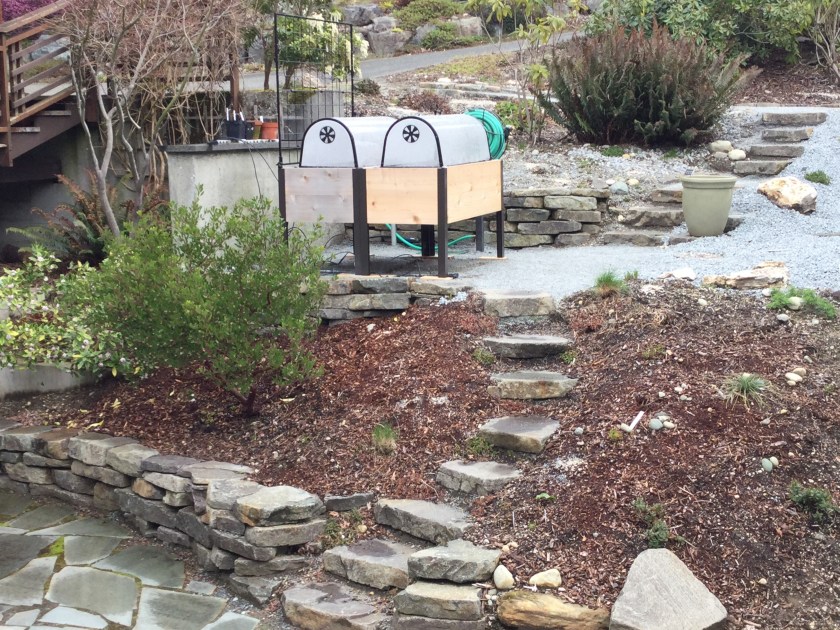
Actually planted one week ago (MARCH 24), after we set up and filled the second of our raised planter boxes. They are 4 x 2 feet, and raised about 3 feet off the ground. Next to each other, they are 16 square feet total planting space:
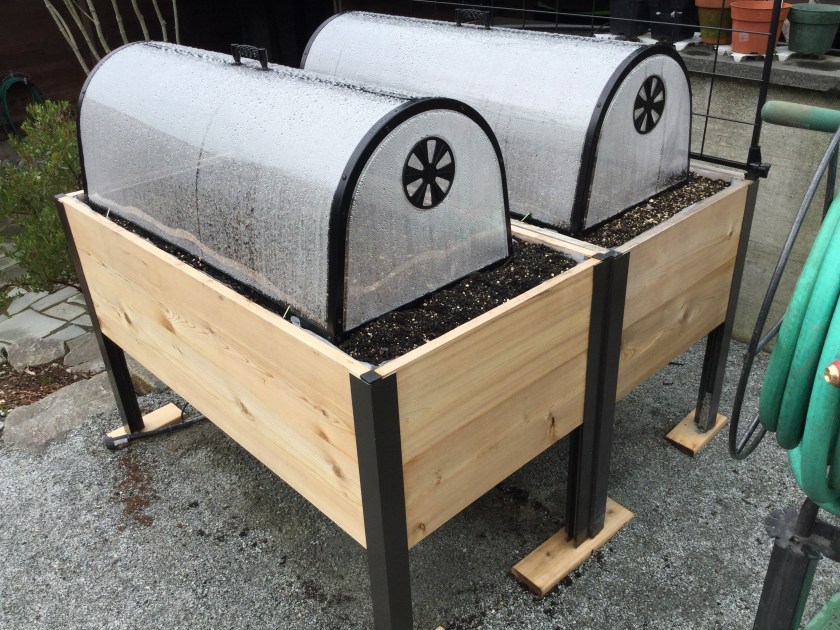
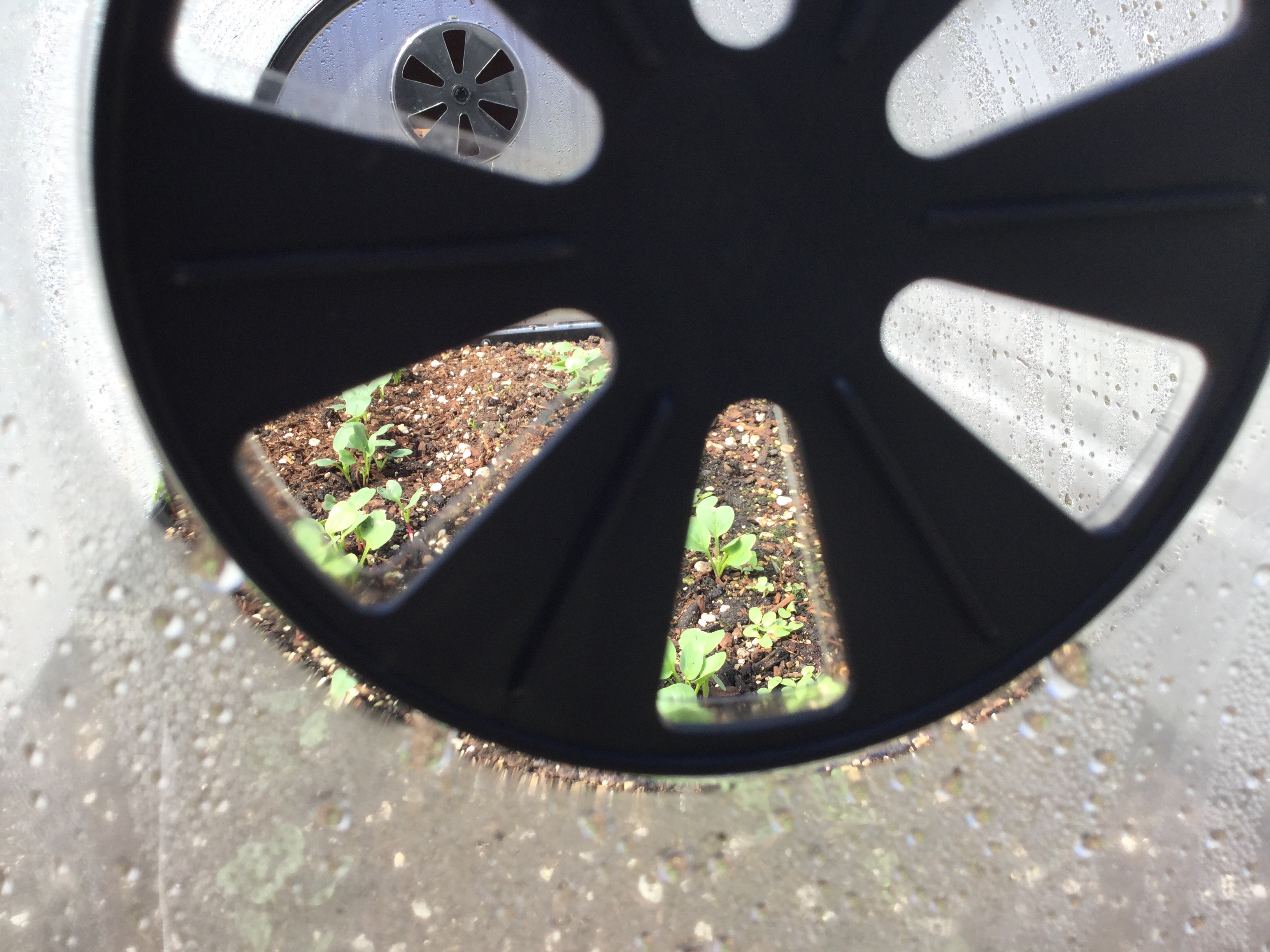
The photo below is peering in……the radish seeds sprouted after 4 days, the lettuce after 6!! Probably due to the cloches, keeping the cold rain out.

We bought two large plastic and metal cloches to extend the growing season and speed up some of the plants by providing warmth and protection from all the cold spring rain we’ve been getting and from sprout-eating vermin. Unfortunately, sprout eating vermin appears to likely involve deer now. We found deer prints in the soft ground in the back yard yesterday, and of course caught one red handed last fall, the first sighting of a deer in the twenty two years we’ve lived here. I didn’t want to bother with the fabric type cloches, those would blow away with our first good wind!  Even these need little metal spikes to secure them. They cover most but not all of the space, but this works for an early planting.  I will probably remove these cloches and plant along the uncovered borders when it warms up. Also got a square metal trellis that attaches onto one side of the planters for the bean and cucumber vines. Soil is potting soil in the back one from last year, and some compost, soil and peat in the front one (dave filled that one). I mixed in some vermiculite and fish fertilizer in each, especially the non-composted one.

I planted the early spring garden: spring onions, carrots, butter lettuce, spinach and radishes inside, and nasturtiums on the corners outside. Except for the north side, with the bean & cucumber trellis. 

Next phase will be the later spring stuff, like pole beans and cucumbers, and finding tomato plant starts. I will be looking for tomato plants that advertise tolerance below 55 degrees…..we had too much ‘flower drop’ happening last year, losing many potential tomatoes to the inevitable temperature dips. So far no tomato starts to buy, must be too early.

Summer sowing is broccoli, and maybe brusssel sprouts ( only got broccoli seeds so far). Also endive is supposed to be good to plant then, for fall. Lettuce is supposed to be cold loving, and if they are protected with cloches, supposedly I can get lettuce nearly all year. But Lettuce doesn’t like the heat. Bulb onions, garlic and leeks are the other fall plantings. Carrots are supposed to be sensitive to the waning light and warmth, so they stop growing in the fall. I actually had tried a container of carrot seedlings from late last summer and they germinated fine but basically stopped growing, though they did withstand all the below freezing temps and snow we had. They are tiny white things that aren’t worth eating, so I turned over the soil in the container.

Recommendations are to take cloves from storebought garlic heads and plant them pointy tip up about two inches apart, in October. This is faster, easier and cheaper than seeds, since we always have some cloves in the house. 

Seed story, beginning of spring (march 26)

Seeds coming up now: Oregon geraniums, Desert Parsley and some Allium, and maybe Gaillardia in pots. Definitely some seedlings out in the yard, maybe gaillardia, Indian Paintbrush, and maybe Woodland Penstemon. Desert Parsley seeds germinate well but seem to be getting eaten out in the yard.

Bought 3 tall Red Ovalleaf huckleberry bushes (4 ft tall and narrow) and transplanted two smaller ones into the south west lower back yard, in an area cleared by removing a maple tree. It gets dappled and indirect sun, and the soil is better and moister than where the two i transplanted were. We have two thriving in a similar environment. Other understory plants put there, some  earlier and  some recently: several Wild Ginger txs, several bluebell rotundifolia txs, clusters of brodiaea, Fairy bells, Trillium Chloropetalum and Ovatum, Pink Fawn Lily, Kitten tails, Miterwort, Hookers Onion, Prunella, and Loganberry. 

Transplanted about half the cluster of Trillium Ovatum in the lower back yard, which I had sown many years ago, maybe six. I transplanted ten bulbs with their three-leave tops into another area, to give the remaining ones a little more room. There are about ten or more left. There are more than germinated the first year or two, and they are of varying maturity. I think some of the seeds are latent or take longer to appear above ground. The cholorpetalum doesn’t seem to do that, I left the 8 or so plants alone.

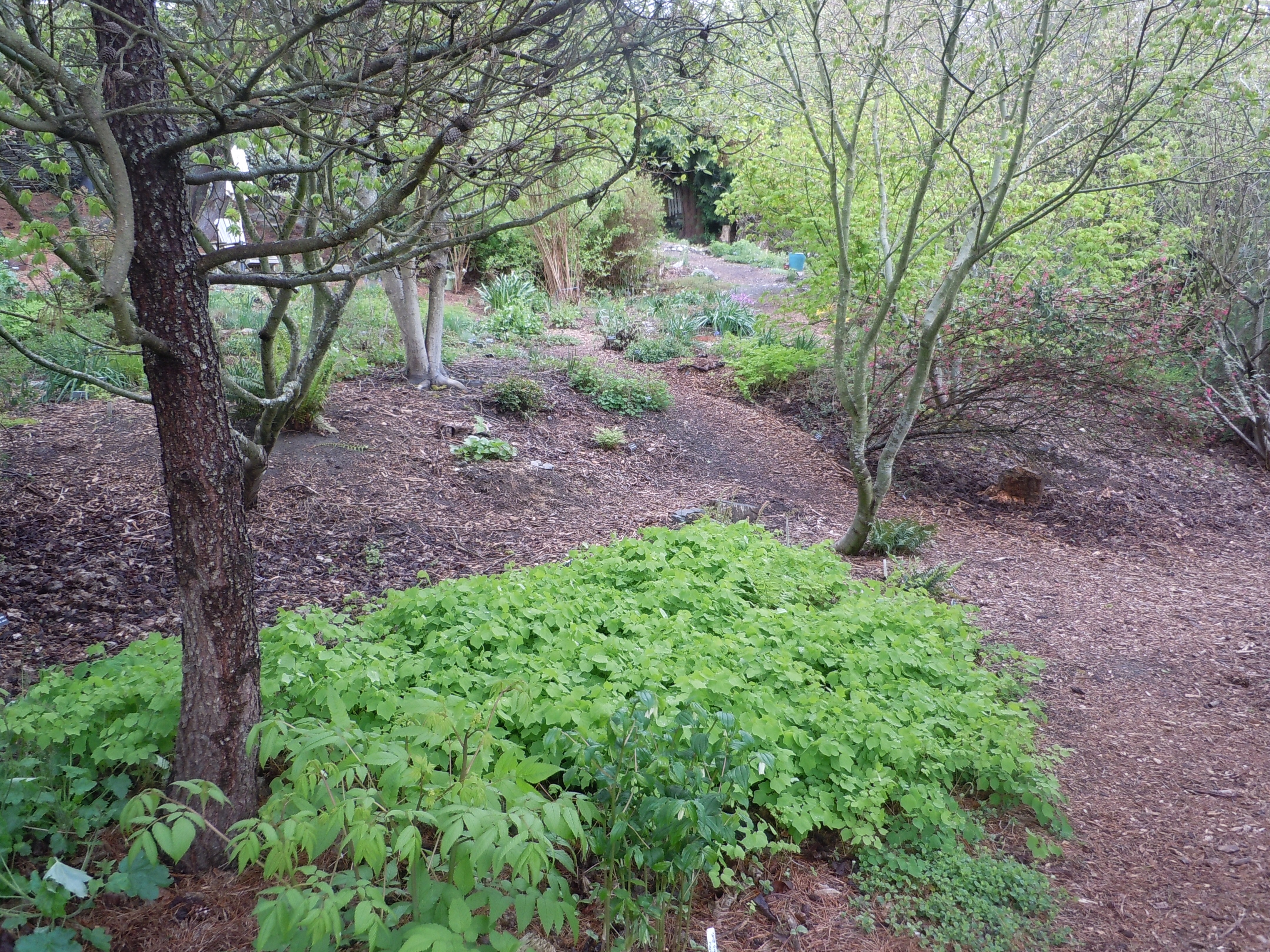
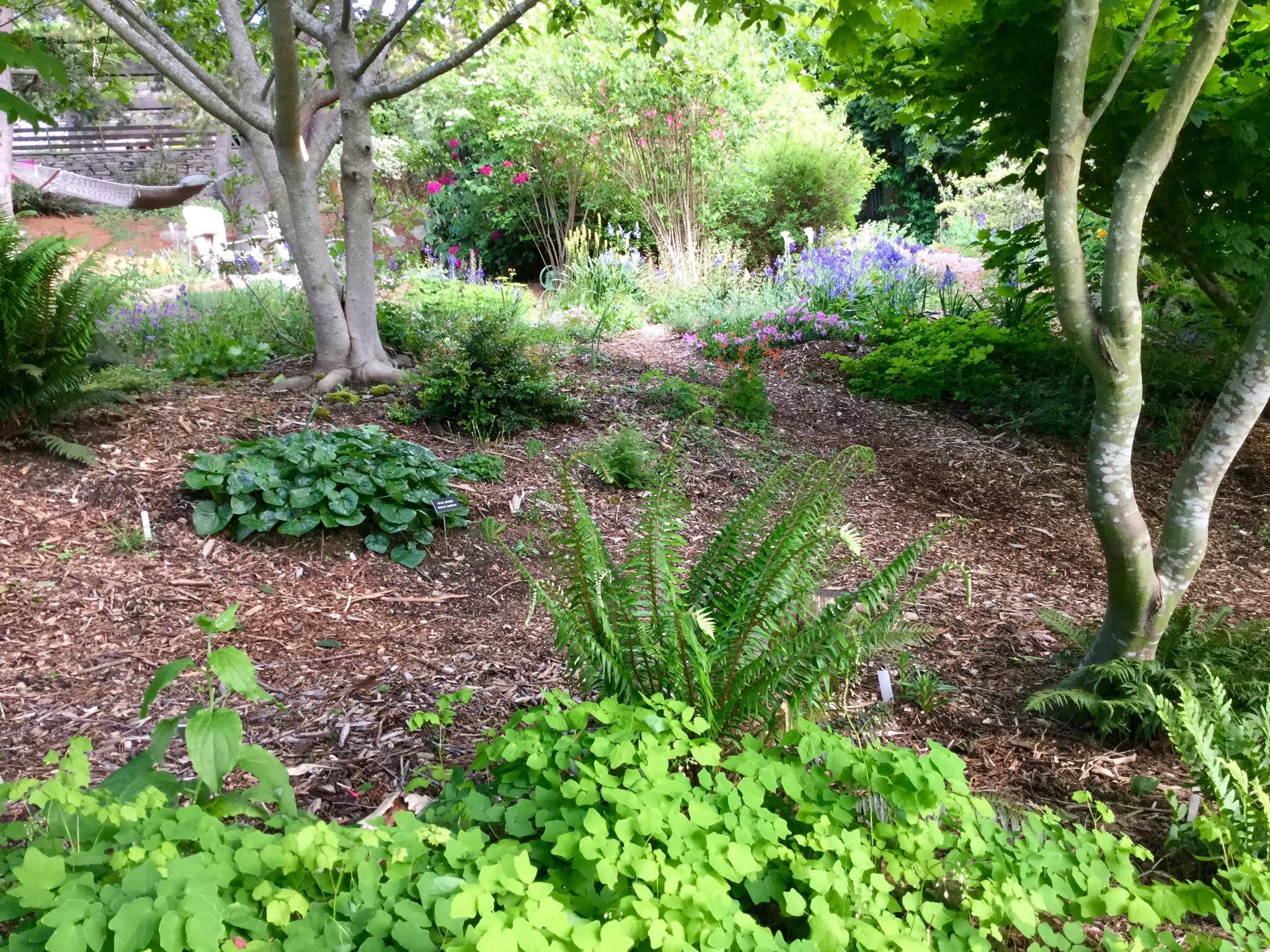
The lower back yard (west) is getting to be a GROTTO with FERNS (thriving licorice, leather leaf, sword and maiden hair) as well as TRILLIUM, HUCKLEBERRIES and the other ground covers like Wild Ginger. Turns out we don’t have very many pictures of this area, probably because it had never been particularly photogenic, it is a shady slower growing area and we’ve cleared the area relatively recently.  But now it is starting to fill in, and a rangy maple taken out (full disclosure, my fault, I kept it low for view), so here are the “before” pics: I may wait for a couple of months for the follow up “during” or “after” shots, as much of it is herbaceous, deciduous and/ or growing still!       

BEFORE PIX: circa 2013 or so    .

Looking south towards new grotto area (upper right in photo)
 Above: The foreground is Vancouvaria and Goats beard coming up…the ‘grotto’ area is in the background. The pic below is taken from the grotto area itself, looking back east.

Spring is here, or march madness (march 19)

What’s up this week? I FINALLY found a Trillium Chloropetalum var. Gigantum at Kruckenbergs garden, which is the one with fragrant deep red/brown and straight-edged trillium flowers instead off white ones (that we have about three of and some maturing seedlings of). I planted it near my maturing off white Chloropetalum and T. Ovatum seedlings in the back yard, that will form an interesting and big Trillium cluster, since the Ovatum flowers are bright white that transition to mauve,and the leaves are plain green heart shaped, and the cholorpetalum are heavily dappled and rounded. I also found a couple of new PINK  fawn lilies there, and planted those with some of my white and yellowish Fawn lily plants and with an off white trillium. Maturing bunch of pink Fawn lillies are planted  with some developing white ones – mix them up a bit for color

Leafy bracked aster is coming up, so far not ravaged by slugs or eaten by voles. In fact I haven’t seen slugs all winter

Chocolate lily up everywhere. I think there are a bunch of Indian Paintbrush (or something) coming up in one of the myriad piles of pumice that I left around the yard, to mark my sowed seeds……I wish I’d marked this one spot, but you know, you can’t have literally hundreds of white plastic markers sticking up all over the yard all winter and not let it get to you! I have to leave these seedlings alone, I’ve been known to pull up I. P. Seedlings by mistake. There are a bunch of bulbs seeds of some kind coming up, either blue or white brodiaea. Desert Parsley (yellow) and Oregon Geranium seeds are all opening up. Maybe a few ( or if they are real, a lot) Indian paintbrush seedlings in the pot. I transplanted three small Yellow Desert Daisy seedlings into the newer ROCK GARDEN INNIS ARDEN, which is to say our new rock garden:

Still march, more updates

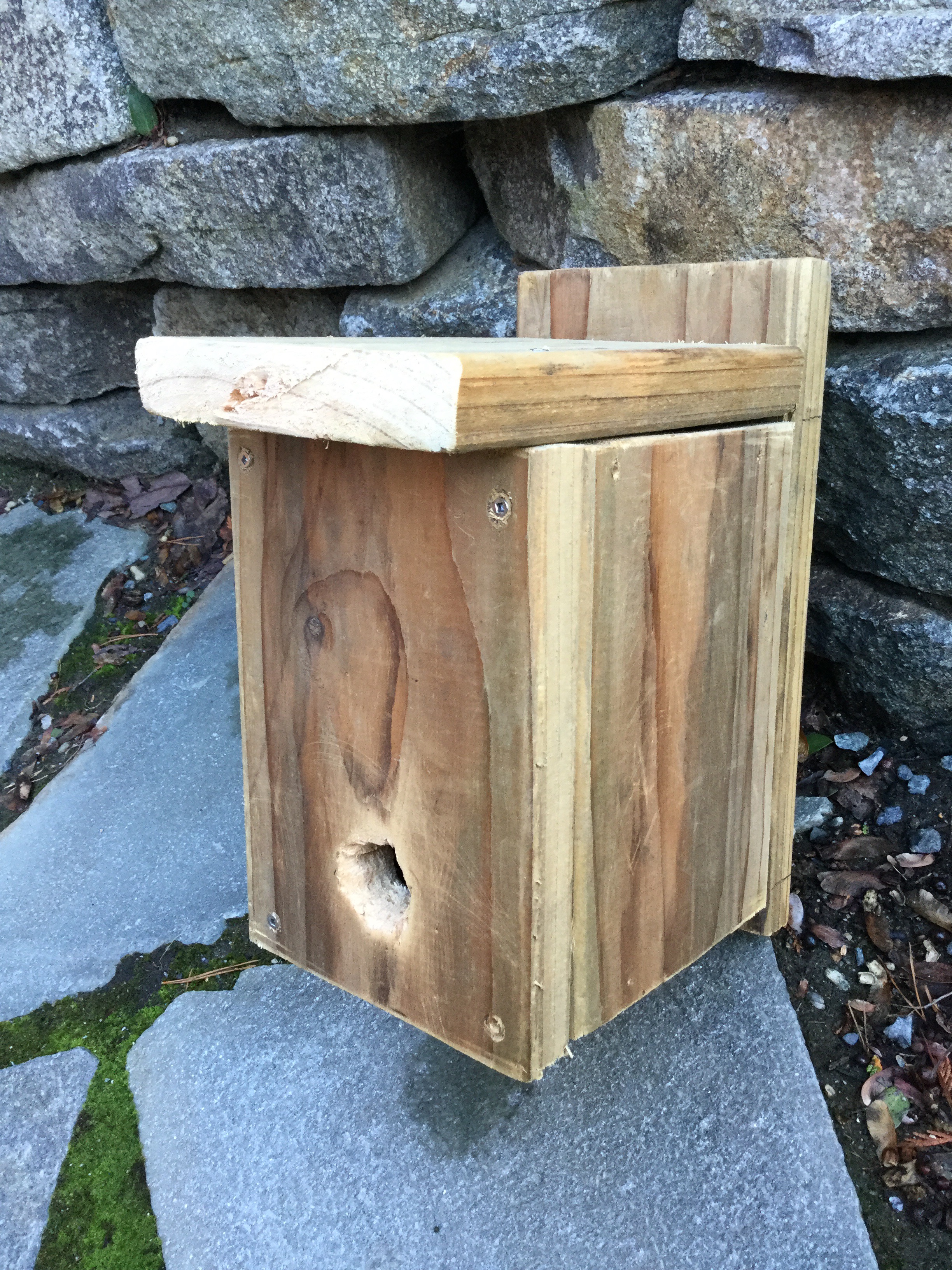
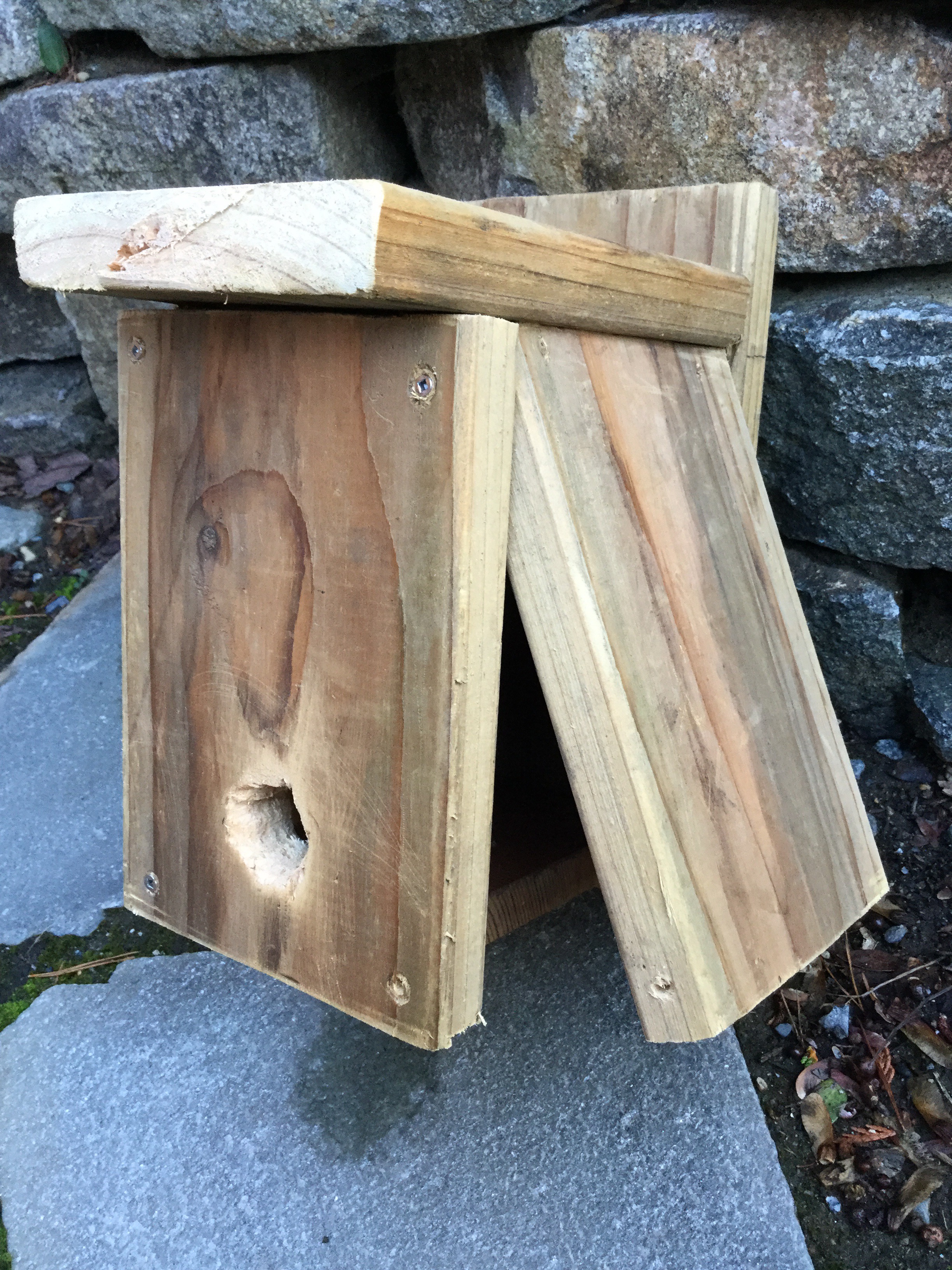
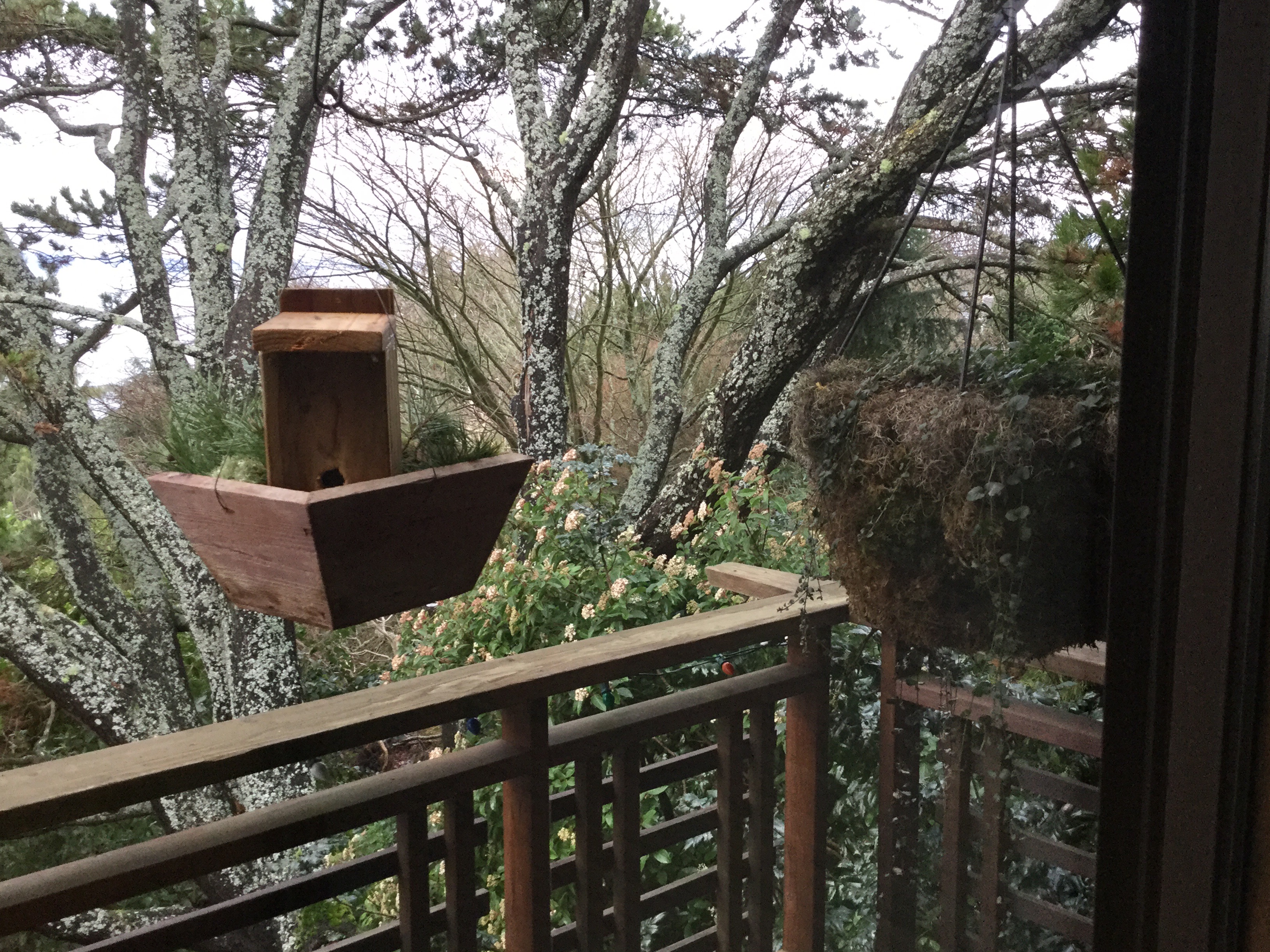
Rufus hummingbirds back, the yard is noisier than ever with those things now. Lots of ducks coming and going in the pond, often four but mostly two now. They don’t seem as skittish this last week, the female walked and rested around the yard, neither flew away when I just walked by. Still no wrens trying out my nesting box – I converted the ‘roosting box’ a couple of weeks ago by inverting the front, so the hole is towards the top. That way there is ventilation (hole in bottom during winter to keep heat in) and some protection for the babies. 

The nesting box is hanging by itself now (not sitting in planter), but is in the same spot. Hoping the wrens are comfortable enough to use it here. If not, will move it for the second brood.

Fawn lillies coming up, including the pink, white and off white! Some Leopard lillies and chocolate lillies just poking up. Oh, and my trilliums from seed…..in the back yard are the oldest ones, I can’t remember if they are arlund 4 or 5 years old now, but there are about 6 of them and they are all going to have the three leaves of a more mature seedling. Any flowers??? Can’t tell yet. But the oldest group also looks like they areTRILLIUM CHOLOROPETALUM (Giant Trillium).  I’ll have to look that up and see whether I recorded the seed sowing or not. Those trilliums are cool, they have blotchy purple spots on the leaves….the flowers are fragrant and straighter in appearance.

OK,  I just looked it all up…..According to my site entries, I apparently sowed some Trillium Chloropetalum seeds in the late summer 2010! That would mean these plants will be 7 years old and should flower this year, even if small.  But, is the first winter considered the “first year”, or does the counting start the next spring? I kind of thought they may be only 5 or 6 years old, judging from how many times I remember watching for them to come up…but how time flies!  In 2012, I even mentioned that I planted out the T.Chloroptelaum ‘bulbs’ along with the mention of the other propagated seedlings (trilliums take two years to ‘germinate’). Anyway, I also wrote that I planted Trillium Ovatum seeds outside and in pots in 2011, so those would be 6 years old now (and POSSIBLY flower), but the plants coming up don’t look that mature. How is it possible to lose track of plants that grow so slowly??!