
Lost all the text from this posting due to a glitch, so won’t repeat. Just wanted to show a couple of critter videos from August. One is of a couple of coyotes in our yard during the day, and another is of a Sharpshinned hawk that got into our house through the doorway (he got out shortly thereafter with a little help). The coyotes are “marking” my Parsnip Flowered Buckwheat, though the second, female coyote actually appears to take a dump on where the male had just marked in front of her…..no respect. Second video is the male coming back to sniff, maybe getting a surprise when he sniffs out the ‘marking’ spot.
Category: Critters
Last of the log feeder
End O’ the log feeder, it has just been taken down. Video of pileated woodpecker, the only time I’ve seen him on this feeder. He was “allowed” on, even though he cleans out the feeder in no time, but he only came around once. Notice how his claws span such a wide area for standing there and how long his beak is. The flickers, however, were NOT welcome, they are too numerous and they also shoo away songbirds and clean out the feeder. They became slingshot target practice (don’t worry, my aim is bad, but at least I got close enough with the slingshot to scare away the squirrels and flickers for long periods of time). Too bad the squirrels got used to the capsaicin in the suet feed, they now tolerate it and they wouldn’t leave this log feeder alone. It was only effective for about ten months. Positioning a wire cage cloche on top hasn’t helped, though it does stymie the flickers. Brand new arrival is a “squirrel proof feeder”, which many many reviewers said works well to keep them out:
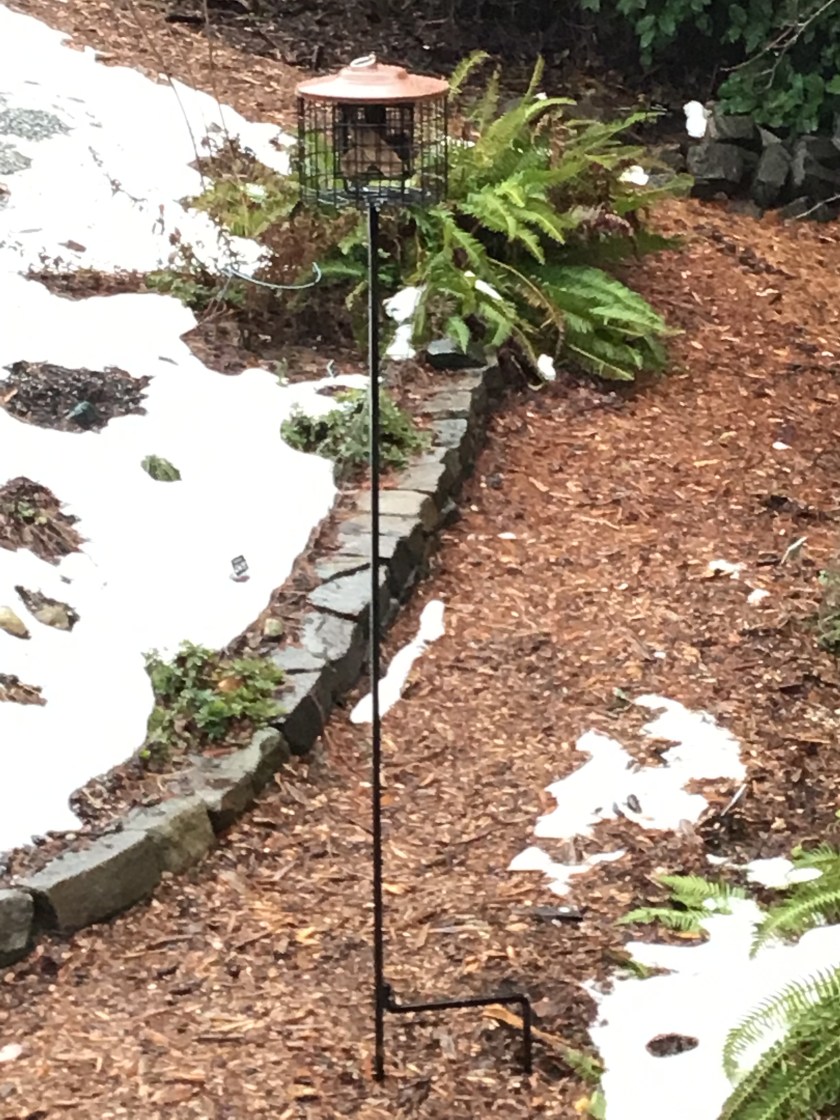
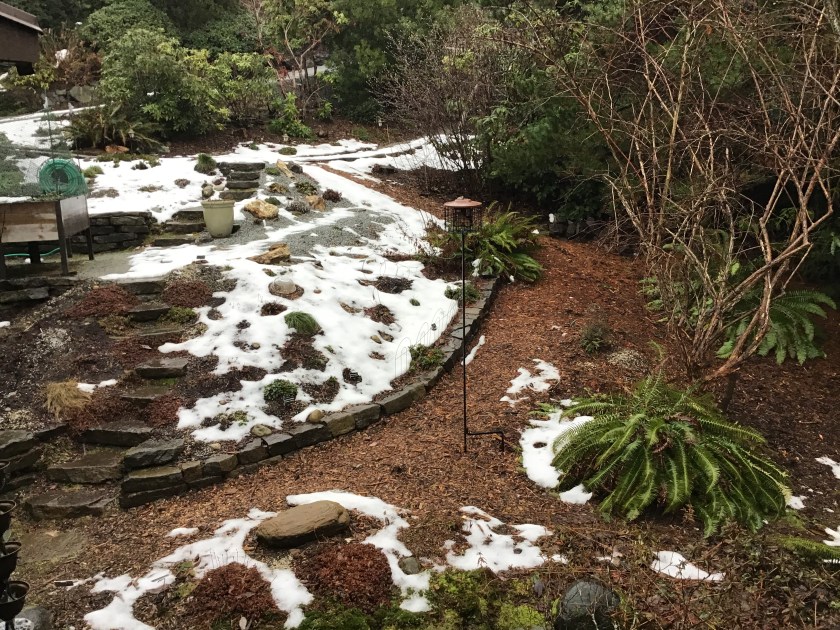

One reviewer didn’t, but they posted a picture with their feeder fixed right to the downspout, giving him lots of opportunity to wriggle in. I looked it up – the squirrel skull is apparently 1.4 inches in width (3.5cm), smaller than the feeder hole sizes of 1.5 inches. The skull height is almost 3 cm, so there isn’t much wriggle room for a squirrel who’s in mid jump or swinging around to get his head and subsequently his shoulders maneuvered in, but a fixed feeder with easy access would eventually be overcome. Above is the feeder we got, in a temporary spot…..it is also supposed to keep the flickers away from most of the suet, which it should be able to do. I don’t plan on putting in two cakes of suet, but rather 1 or 2 suet logs, placed more centrally so the animals that can’t fit into the “feeding space” can’t get to it. I started with the capsaicin logs I still have, but have better suet with buggies in it as well as peanuts. I’m planning on putting that in later, to drive the squirrels NUTS!
February snows, part deux
Bitter cold weather and lots of snow….it was all I could do to try to keep some of the little songbirds fed a bit so they could tolerate the cold, which was descending fast. How could I bring their numbers up in the garden (for our viewing pleasure) if they didn’t survive the winter? A few crushed up peanuts and residual seeds under the bushes here and there helps, and I top off the suet feeder, though the nasty squirrels are now the most persistent feeders, as anyone with bird feeders will tell you. Even using suet with pepper oils in it has suddenly stopped deterring them after almost a year, and they attack not just the suet but chew the shit out of the pine log used to make the feeder. The flickers just eat several days’ worth of the songbirds’ suet in about ten minutes’ time. Only once had a pileated woodpecker visit, and I got some great video (see next entry). Placing wire cage cloche over the feeder log hasn’t helped with the squirrels, nor the appearance(one of the cloches is in the background of the video below). I’ve resorted to purchasing a squirrel and flicker proof caged feeder, which doesn’t allow the squirrels into the space around the suet, that should help in a few days when it arrives. And then to top it off, I ordered the good stuff to use in it, that the squirrels and flickers really like, so I can drive them nuts for a change.
The good news is that Wiley is back, having not been on camera since late November. He appears to have at least detected the pork roast bone and gristley parts, though he missed them by two hours since the crows got there first- the place he ends up sniffing at the end.
Finally caught a wren on the video, hopping up into one of their favorite roosts. They usually just go there at nights, but are also known to cozy away during inclement weather, which we were experiencing, with sub freezing temps and intermittent heavy snowfalls. In the past they have been more consistent about staying in the same holes, etc. but maybe there are lots of places for them to stay. Also not sure yet if they are going into wren box and just not being detected…….this video capture was likely compliments of the chickadee who wrestled around right next to the camera first.
February snowstorms


Somewhat of a surprise to the area, I think we may have had the most snow in the area, but everyone got wind. Our power was out for a few hours. It will be freezing temps for the next two days, too, so I put out some extra suet lumps stuck on the feeder, sunflower seeds and bread crumbs. Hard to find areas that aren’t inundated with snow, so mostly under bushes where birds like to feed anyway.
Ookow coming up now, the leaves spiky stalks of dark purple green. The deer sometimes eat their purple allium type flowers, once the leaves and then flower stalks reach about three feet high. We’ll just have to see if all the “deer fence”, the 18″ high nearly invisible segmented fencing I recently put up around a few vulnerable areas, will protect them and my other delicate plants from all the trampling the deer do.
Deer rant: Of course deer can “jump” the fence, but there’s not much reason to do any jumping, plus these are arranged in circles. They’re meant to divert the deer around, preferably back to the path. Good thing most plants were dormant when all that rutting was going on! (See previous entry from December).The ground was full of deep hoof holes, that’s one reason for the extra fence circles. I’m also not sure they would have completely respected the fence borders during the rutting, but we’ll see next year. So far after a month, no disturbance of the four fenced circles or new hoof holes within them. One fence has been undisturbed for three months. I also put 5 bronze metal cage cloches on a few new huckleberry and their plants that the deer ate down to the ground, to give them half a chance (the sixth one of the set helps keep the flickers out of the suet feeder, though the songbirds did need to learn how to use it).
We haven’t seen deer in the videos since November. We saw coyote prints all across the lower back yard just today after all the snow….too bad the camera batteries were out then, the coyotes hadn’t been seen on camera since late November. We were just wondering about it the other day, whether their routes into the ‘hood were cut off. Just in case, though, I need to remember to order some insect barrier to put over the young ash trees…..the bird netting holes are too large and it falls down, which won’t help protect the leaves from the deer at all. I need to look online and see what if anything exists between that size and mosquito netting.
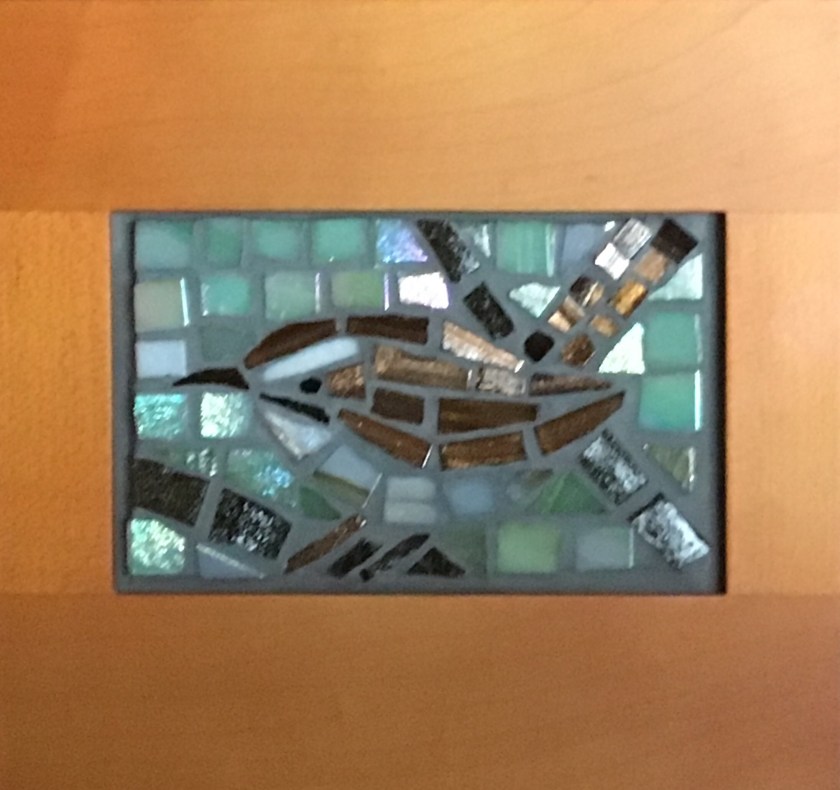
Repurposed several photo frames from the last few decades to house new little photo-sized mosaics of birds. We don’t have much room for photo displays around here- they collect dust on countertops and then eventually sit in a drawer. I made four but only finished glueing three, since one needs some serious sanding to make it centered and is not that great. They are small, the wren is 2 1/2″ x 4″, the largest jay is 4 x 6″, the woodpecker in between. Anyway, here are the birds in all their glory: (looks like I need to clean a woodpecker tile)


January news
Tritelleia is coming up! That is, if the trampling deer don’t squash it. And a few of the Camas bulbs I transplanted around due to their dormancy where they had been under the pines: Howelli and Cusecki. Little bits of Castilleja, penstemons, wild blue flax, bluebells , leafing out.
The coyotes have been around, but Wiley’s a little late to the party this time:
The coyotes aren’t the only ones partying pond-side:
Finally found cloches that just keep vermin from eating the plants. Rusted-bronze cages that self-stake into the ground. They blend into the mulch, you can hardly see them. I’ve put 4/6 around so far, maybe the two little red huckleberry plants the deer have leveled will forgive me and come back to grace the yard. I’ve also put up four low portable linking fences that also self-stake, circling places the deer have injured but need to stay out of. They are also hard to see, fortunately, so I must stay on trail. So far none have been breached or moved at all, including one that has been there about a month. I am presuming the deer and other critters who have not brought down my modest fence can see it and just choose to go around, which is what I am trying to achieve.
December already
Now the deers are rutting, in our backyard!
Thats where all the deer-hoof holes were from in our lower back yard. Usually they’re a trail of sorts, these were all over. Oh, and it’s kind of a spa, too. They hung around for a while, and made about 12 videos:
Middle o’ the day coyote visitation
Missed him in the yard today by about 20 minutes (his name is actually Wiley but I call him Pretty Boy):
I’ll have to be more stealth when I go out, he could have been there one of the times I was out there this am. Would like to catch them live, like I did the deer pair. He’s more skittish than the raccoons, who don’t give a fuck that you’re there.
November transitions
Had to water the yard a few times this past summer, but not much after the last post….a few good rains helped the green last through to this month at least. The deciduous tree leaves have mostly fallen, but the ground cover greens persist. Even the visitors to the yard agree:
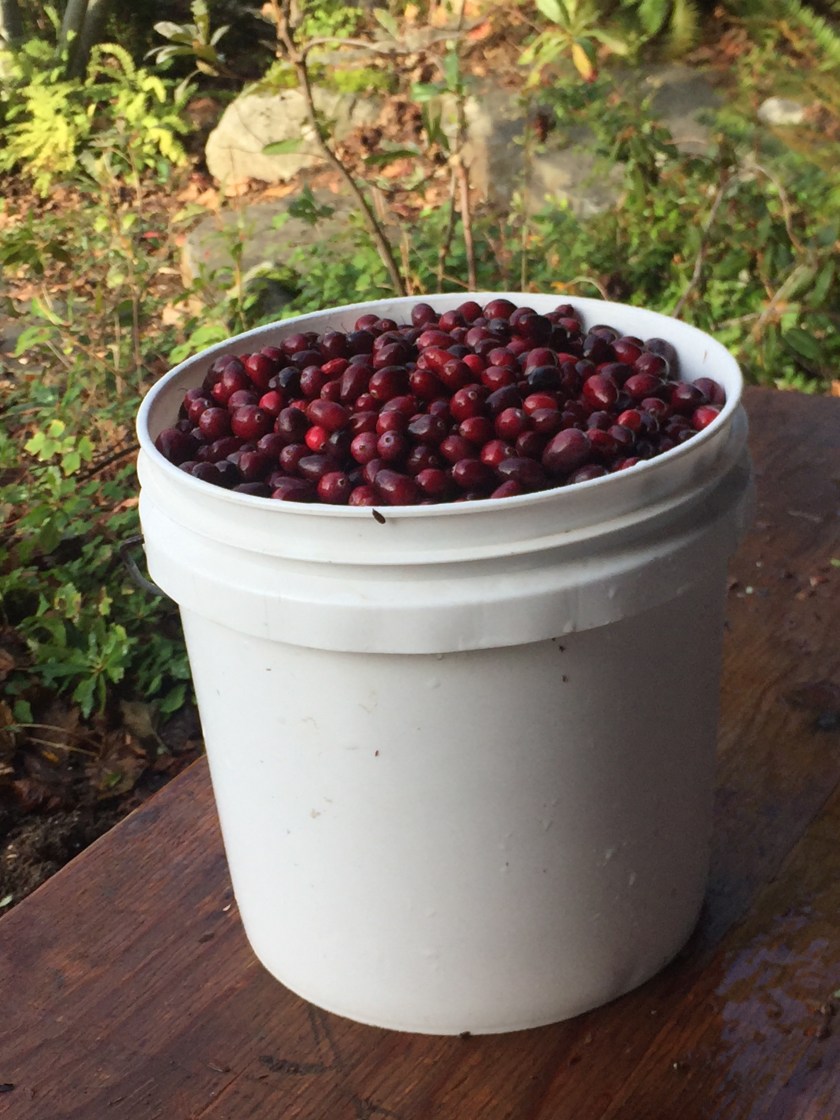
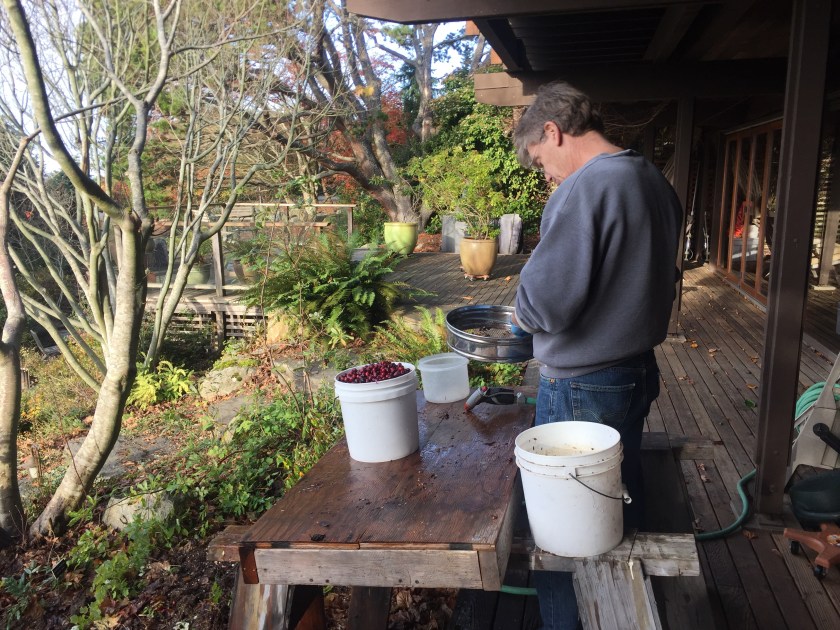
Also, we finally harvested our year’s bounty of cranberries: just over two gallons! They’re all cleaned and frozen now. Can’t wait till they’re honey marinated and dried – yum.
Ducks in the hood
Arrived yesterday. Wasn’t sure what was splashing around there, but a pair showed up. About 3-4 weeks early.
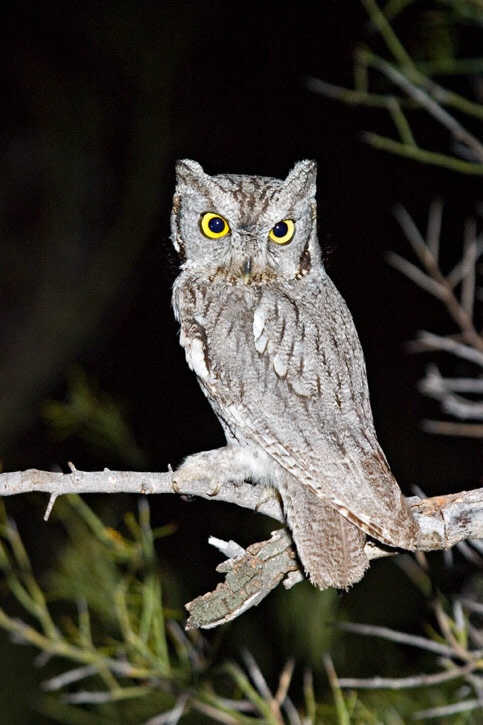
More plants emerging: tiniest new Castilleja Miniata (red) Indian paintbrushes, Silk Flower, with one flower open already for a week….tough little bugger, still there after snow and hail, and Fawn lillies. I believe I planted a lot of fawn lillies, although the little shit vole has decided those are OK with him, so we’ll see. They’re definitely not bunched into clumps like the Brodiaea, which also can “self-clump”, so maybe they won’t be as good a target for the vole. Until they get nice and mature, and wham! When oh when will the screech owl ever show up? His splendid new abode awaits him, king of all he surveys.
Just a little record keeping
Coyote by daylight, looking for his rib bone. I put it there to keep him in front of the camera longer. He eventually found it….see below
Seasonal garden occurrences: Monkshood is ‘leafing out’, as of last week. White Tritellia coming up. Both in the backyard, maybe I should transplant? The Cuseckii (light blue) Camas are coming up in the various places I transplanted , hopefully they’ll recover and bloom once again. I haven’t definitely seen the Howellii Camas which are similar color but different appearance, the other light blue Camas bulb patch I had to transplant due to failure to thrive. All the other blue and the white Camas are thriving, to the point where we considered cultivating it for eating. We have gathered and slow cooked it (see former post) a couple of times, but it is work. I can see how potatoes won out over Camas in the Native communities.
All seeds finally in the ground, although not all landscaping projects are complete. I hand finished some of the front yard where I wanted to plant, and where we had take out lots of Oregon grape, and various other non native plants as well as transplanting the large fern from there to the backyard (it already likes it better). Ten bags of top soil, potting soil, cactus soil sand and gravel filled in the fern divet and covered the areas for seed and plant/transplant. New Lewisia Cotyledons and Tweedyi for the front, a Castilleja Miniata Paintbrush, Penstemon Newbergii with crimson flowers, and the seeds of Irises Chrysophylla (white with purple and yellow stripes), Setosa (dark purple blue), and Siskou (yellow), and seeds of Buckwheats, bear grass, monardella and some other rock garden favorites.
 ellensgarden.us