Last of the log feeder

End O’ the log feeder, it has just been taken down. Video of pileated woodpecker, the only time I’ve seen him on this feeder. He was “allowed” on, even though he cleans out the feeder in no time, but he only came around once. Notice how his claws span such a wide area for standing there and how long his beak is. The flickers, however, were NOT welcome, they are too numerous and they also shoo away songbirds and clean out the feeder. They became slingshot target practice (don’t worry, my aim is bad, but at least I got close enough with the slingshot to scare away the squirrels and flickers for long periods of time). Too bad the squirrels got used to the capsaicin in the suet feed, they now tolerate it and they wouldn’t leave this log feeder alone. It was only effective for about ten months. Positioning a wire cage cloche on top hasn’t helped, though it does stymie the flickers. Brand new arrival is a “squirrel proof feeder”, which many many reviewers said works well to keep them out:

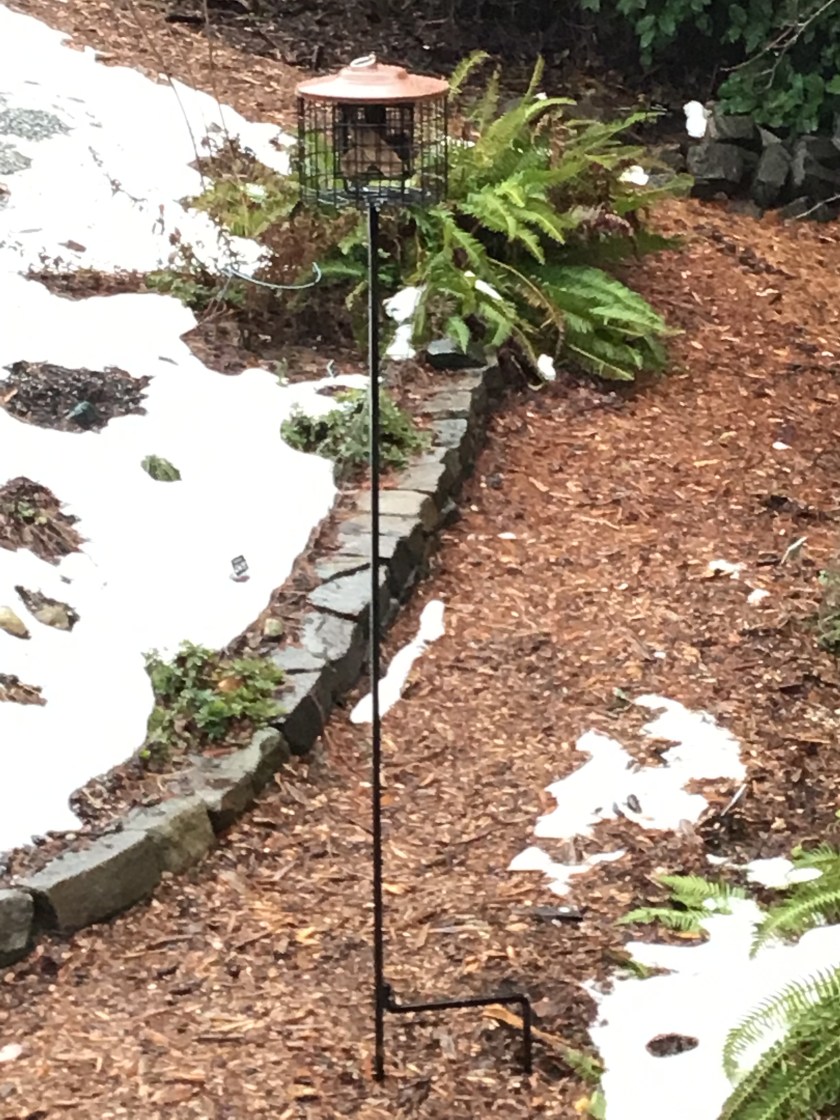
One reviewer didn’t, but they posted a picture with their feeder fixed right to the downspout, giving him lots of opportunity to wriggle in. I looked it up – the squirrel skull is apparently 1.4 inches in width (3.5cm), smaller than the feeder hole sizes of 1.5 inches. The skull height is almost 3 cm, so there isn’t much wriggle room for a squirrel who’s in mid jump or swinging around to get his head and subsequently his shoulders maneuvered in, but a fixed feeder with easy access would eventually be overcome. Above is the feeder we got, in a temporary spot…..it is also supposed to keep the flickers away from most of the suet, which it should be able to do. I don’t plan on putting in two cakes of suet, but rather 1 or 2 suet logs, placed more centrally so the animals that can’t fit into the “feeding space” can’t get to it. I started with the capsaicin logs I still have, but have better suet with buggies in it as well as peanuts. I’m planning on putting that in later, to drive the squirrels NUTS!

February snows, part deux

Bitter cold weather and lots of snow….it was all I could do to try to keep some of the little songbirds fed a bit so they could tolerate the cold, which was descending fast. How could I bring their numbers up in the garden (for our viewing pleasure) if they didn’t survive the winter? A few crushed up peanuts and residual seeds under the bushes here and there helps, and I top off the suet feeder, though the nasty squirrels are now the most persistent feeders, as anyone with bird feeders will tell you. Even using suet with pepper oils in it has suddenly stopped deterring them after almost a year, and they attack not just the suet but chew the shit out of the pine log used to make the feeder. The flickers just eat several days’ worth of the songbirds’ suet in about ten minutes’ time. Only once had a pileated woodpecker visit, and I got some great video (see next entry). Placing wire cage cloche over the feeder log hasn’t helped with the squirrels, nor the appearance(one of the cloches is in the background of the video below). I’ve resorted to purchasing a squirrel and flicker proof caged feeder, which doesn’t allow the squirrels into the space around the suet, that should help in a few days when it arrives. And then to top it off, I ordered the good stuff to use in it, that the squirrels and flickers really like, so I can drive them nuts for a change.

The good news is that Wiley is back, having not been on camera since late November. He appears to have at least detected the pork roast bone and gristley parts, though he missed them by two hours since the crows got there first- the place he ends up sniffing at the end.

Finally caught a wren on the video, hopping up into one of their favorite roosts. They usually just go there at nights, but are also known to cozy away during inclement weather, which we were experiencing, with sub freezing temps and intermittent heavy snowfalls. In the past they have been more consistent about staying in the same holes, etc. but maybe there are lots of places for them to stay. Also not sure yet if they are going into wren box and just not being detected…….this video capture was likely compliments of the chickadee who wrestled around right next to the camera first.

February snowstorms

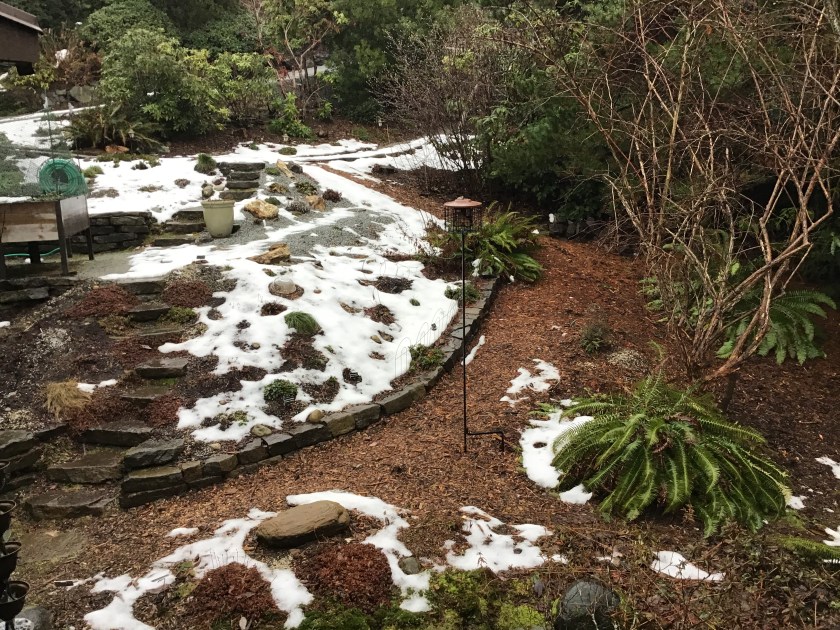
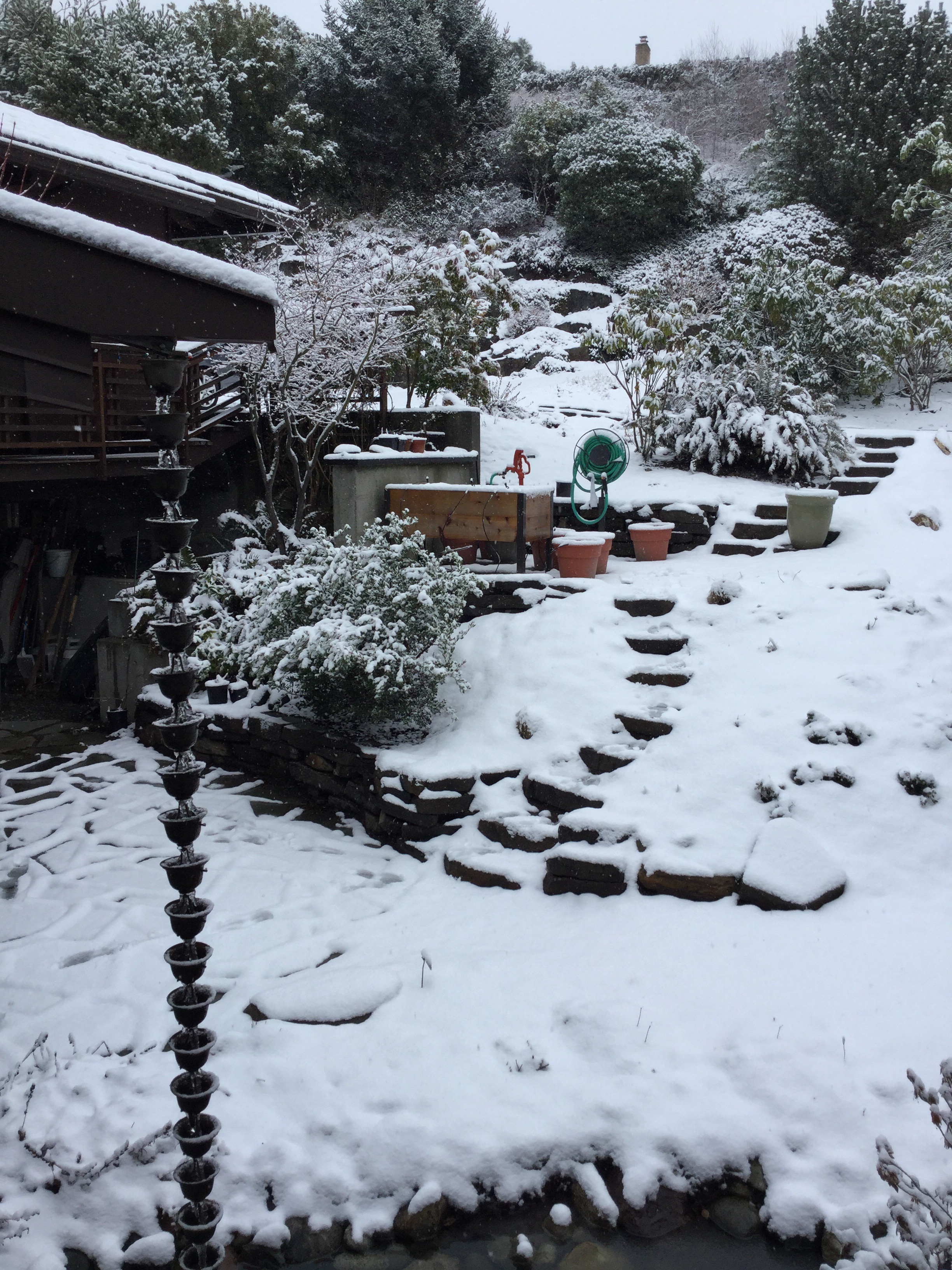
Somewhat of a surprise to the area, I think we may have had the most snow in the area, but everyone got wind. Our power was out for a few hours. It will be freezing temps for the next two days, too, so I put out some extra suet lumps stuck on the feeder, sunflower seeds and bread crumbs. Hard to find areas that aren’t inundated with snow, so mostly under bushes where birds like to feed anyway.

Ookow coming up now, the leaves spiky stalks of dark purple green. The deer sometimes eat their purple allium type flowers, once the leaves and then flower stalks reach about three feet high. We’ll just have to see if all the “deer fence”, the 18″ high nearly invisible segmented fencing I recently put up around a few vulnerable areas, will protect them and my other delicate plants from all the trampling the deer do.

Deer rant: Of course deer can “jump” the fence, but there’s not much reason to do any jumping, plus these are arranged in circles. They’re meant to divert the deer around, preferably back to the path. Good thing most plants were dormant when all that rutting was going on! (See previous entry from December).The ground was full of deep hoof holes, that’s one reason for the extra fence circles. I’m also not sure they would have completely respected the fence borders during the rutting, but we’ll see next year. So far after a month, no disturbance of the four fenced circles or new hoof holes within them. One fence has been undisturbed for three months. I also put 5 bronze metal cage cloches on a few new huckleberry and their plants that the deer ate down to the ground, to give them half a chance (the sixth one of the set helps keep the flickers out of the suet feeder, though the songbirds did need to learn how to use it).

We haven’t seen deer in the videos since November. We saw coyote prints all across the lower back yard just today after all the snow….too bad the camera batteries were out then, the coyotes hadn’t been seen on camera since late November. We were just wondering about it the other day, whether their routes into the ‘hood were cut off. Just in case, though, I need to remember to order some insect barrier to put over the young ash trees…..the bird netting holes are too large and it falls down, which won’t help protect the leaves from the deer at all. I need to look online and see what if anything exists between that size and mosquito netting.

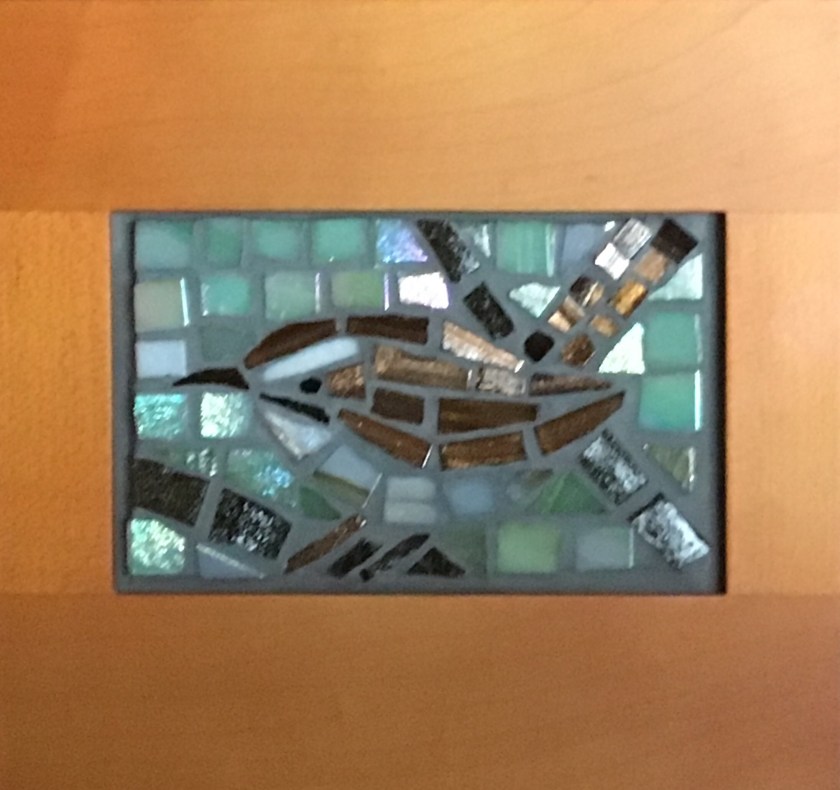
Repurposed several photo frames from the last few decades to house new little photo-sized mosaics of birds. We don’t have much room for photo displays around here- they collect dust on countertops and then eventually sit in a drawer. I made four but only finished glueing three, since one needs some serious sanding to make it centered and is not that great. They are small, the wren is 2 1/2″ x 4″, the largest jay is 4 x 6″, the woodpecker in between. Anyway, here are the birds in all their glory: (looks like I need to clean a woodpecker tile)

January news

Tritelleia is coming up! That is, if the trampling deer don’t squash it. And a few of the Camas bulbs I transplanted around due to their dormancy where they had been under the pines: Howelli and Cusecki. Little bits of Castilleja, penstemons, wild blue flax, bluebells , leafing out.

The coyotes have been around, but Wiley’s a little late to the party this time:

The coyotes aren’t the only ones partying pond-side:

Finally found cloches that just keep vermin from eating the plants. Rusted-bronze cages that self-stake into the ground. They blend into the mulch, you can hardly see them. I’ve put 4/6 around so far, maybe the two little red huckleberry plants the deer have leveled will forgive me and come back to grace the yard. I’ve also put up four low portable linking fences that also self-stake, circling places the deer have injured but need to stay out of. They are also hard to see, fortunately, so I must stay on trail. So far none have been breached or moved at all, including one that has been there about a month. I am presuming the deer and other critters who have not brought down my modest fence can see it and just choose to go around, which is what I am trying to achieve.

Coming up Camas

About November 20th I noticed the re-planted my patch of Camassia Cusick popping up in a couple of different places. I replanted it because it was not doing well where it was…….it hadn’t flowered in a few years and this year even the leaves looked weaker and started to turn brown and spotted after coming up. It’s actually right next t some common Camas, which has always done great. I just cut it to the ground and covered it with mulch, in case there was an infection. When I dug the bulbs back up this fall, they looked fine, once I’d washed the slimy bulb cover off, so I planted them around. Fingers crossed. I haven’t seen the Howells camas that I also replanted in the yard. That patch wasn’t diseased looking but the flowers and finally the leaves looked anemic, and it also stopped flowering. Those bulbs looked just fine, if maybe a little smaller than the Camassia Quamash (common camas), but they seemed to have been stopped from growing deeper like they should have….maybe the soil was too firm, or not good? Anyway, those were super easy to take out, as opposed to the other camas that takes quite a dig, and they came right out. They looked like the bulbs were trying to grow sideways, that’s why I think the soil was a problem. Maybe there’s some big ole rock underneath that I haven’t seen yet. I planted bulbs from each site both in the front and the back. I’ve covered the new Cuseckii shoots because we now have…….

Deer! The little shits are actually coming around during the day. I found two together in our yard last week – a big stag and a doe, around 11 am. They ran into the next doors yard, and let me watch them from the street for a while. Then they wandered back into my yard, as if I didn’t see them. I went back and watched them for a while, got bored with them and then charged them to make them run (fast- into the north neighbors yard) which was fun to see. I don’t get to see stags take off like lightning. They don’t eat many of our plants, although they do nibble on new camas leaves in the spring, so I covered some of the newest shoots with a glass cloche, just in case. And they eat the flower buds of Brodiea and one of the Heucheras. They also trample a lot in certain places, especially part of our backyard sunny meadow. I arranged 8 tomato cage ‘towers’ stuck in a circle around the area to keep them out and force them to find a new path, so some of the seeds can establish and the herbaceous plants won’t be trashed when they try to come up. They don’t seem to like using stone steps or gravel paths – they trod on the soft wet mud instead.

Well, I did get something to try and discourage them, but not sure it will work. They sell coyote pee and wolf pee, in crystals and liquid. We got the wolf pee crystals, but not sure the animals even know what a wolf is or what it smells like – we don’t have wolves! It got better “ratings.”in general than the coyote pee on their website, but then, those were probably folks who lived near wolves. Arguably, it should have crossed our minds that there are no wolves within hundreds of miles of here. And that’s how powerful marketing is.

March madness – duck saga

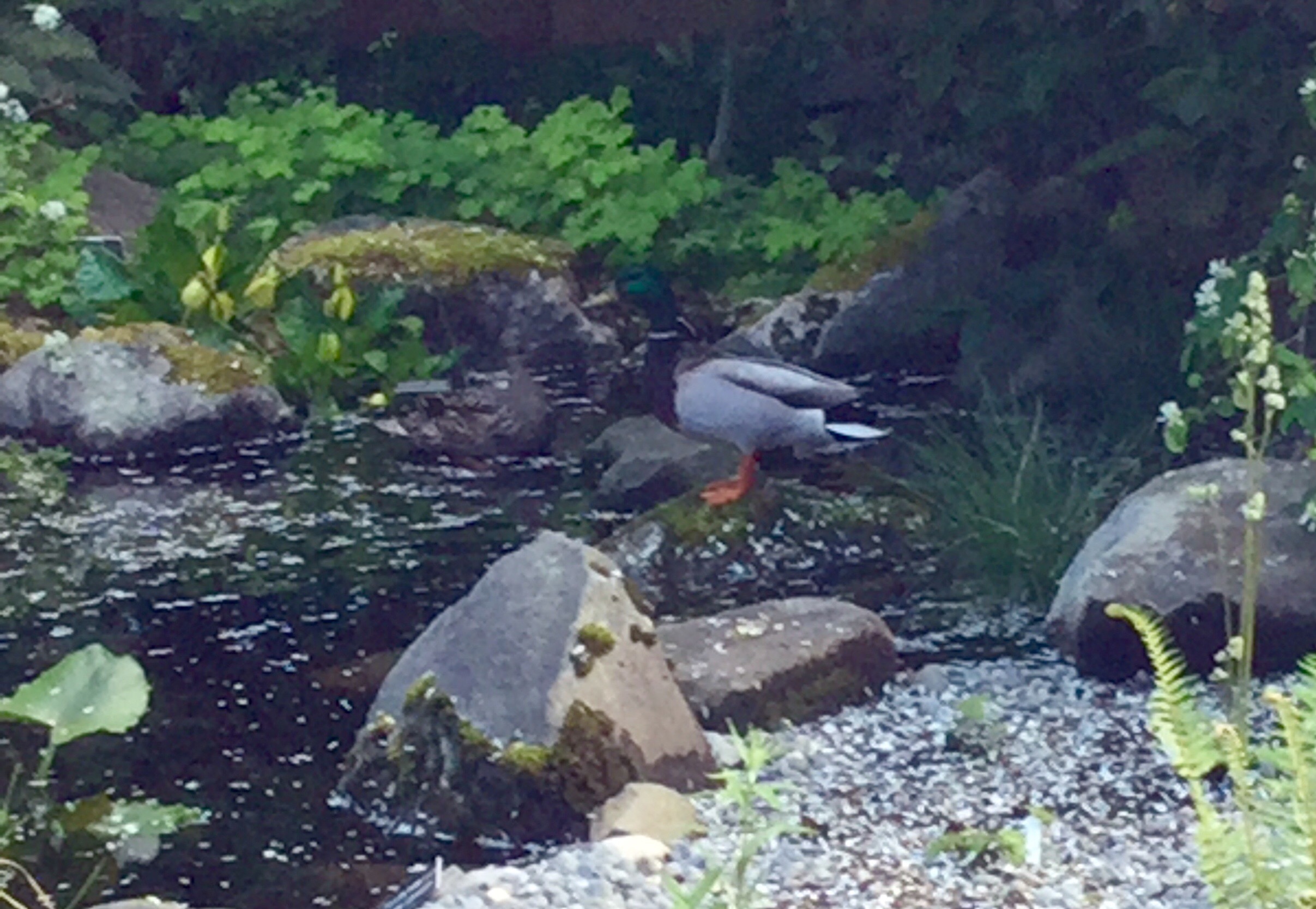
I happened upon a BUNCH of ducks in our pond yesterday ….a raft or team of ducks, apparently. They are only called a flock while in flight. I didn’t even see them and FOUR of them flew away. As I approached more, TWO MORE flew away. That makes SIX DUCKS in the pond at the same time, not fighting. Today I scared away four ducks, two at a time. And by scare away I mean simply walk down the steps….these are real ‘fraidy ducks. I think they have become that way because of the growth of the shrubs around the pond…their potential emergency exit isn’t what it used to be. I used to be careful not to get too close but so far this year I couldn’t even walk into the yard without scaring them away. Too bad for them!

Trillium seedlings starting to come up!  I think these are from sowings about 4-6 years ago  – the one patch showing up has seedlings from two different years. One of this patch had three leaves last year, and at least three of them now look like they are fairly mature looking as they poke up. They typically take 7 years to flower from seed, but can be as soon as 5 depending on the conditions. Exposing seeds to warm conditions early can cause this, maybe it happened naturally. Last year there only a few trillium flowers, maybe they didn’t  like those early warm springs we’ve had, so maybe not so good for the flowering as it is for forcing the seedling. And almost no seeds, only the Trillium Chloropetalum produced seeds last year, which will not appear until next year (if they do). Trilliums take two years to appear above ground.

Ducks in the hood – last day of February

Duck sightings/hearings last week (and while we’re at it, we heard the tree frogs, too). I first “saw” them by finding a handful of their light colored feathers in the pond, and no bird body!

Fawn lillies and Trillium chloropetalum finally poking up. Goatsbeard, Wyethia (humble ears)and Fairybells also showing their ‘spikes’ of leaves.

Also, yesterday we got rid of a bunch of small trees and the pile of pruning branches I’ve accumulated all year (had the work done). Not too much foot damage to the plants, much appreciated, and it was also I think early enough to avoid most plant damage.Our neighbor, the one who always whined about us taking out trees, now wants us to “window” out one of our pines. This may be an opportunity to deal – a couple of the their hemlocks need lowering to open up the view to the beach.

We had a late snow yesterday, after a couple of weeks of mild weather. But it looks like everything is still doing OK.

February progress

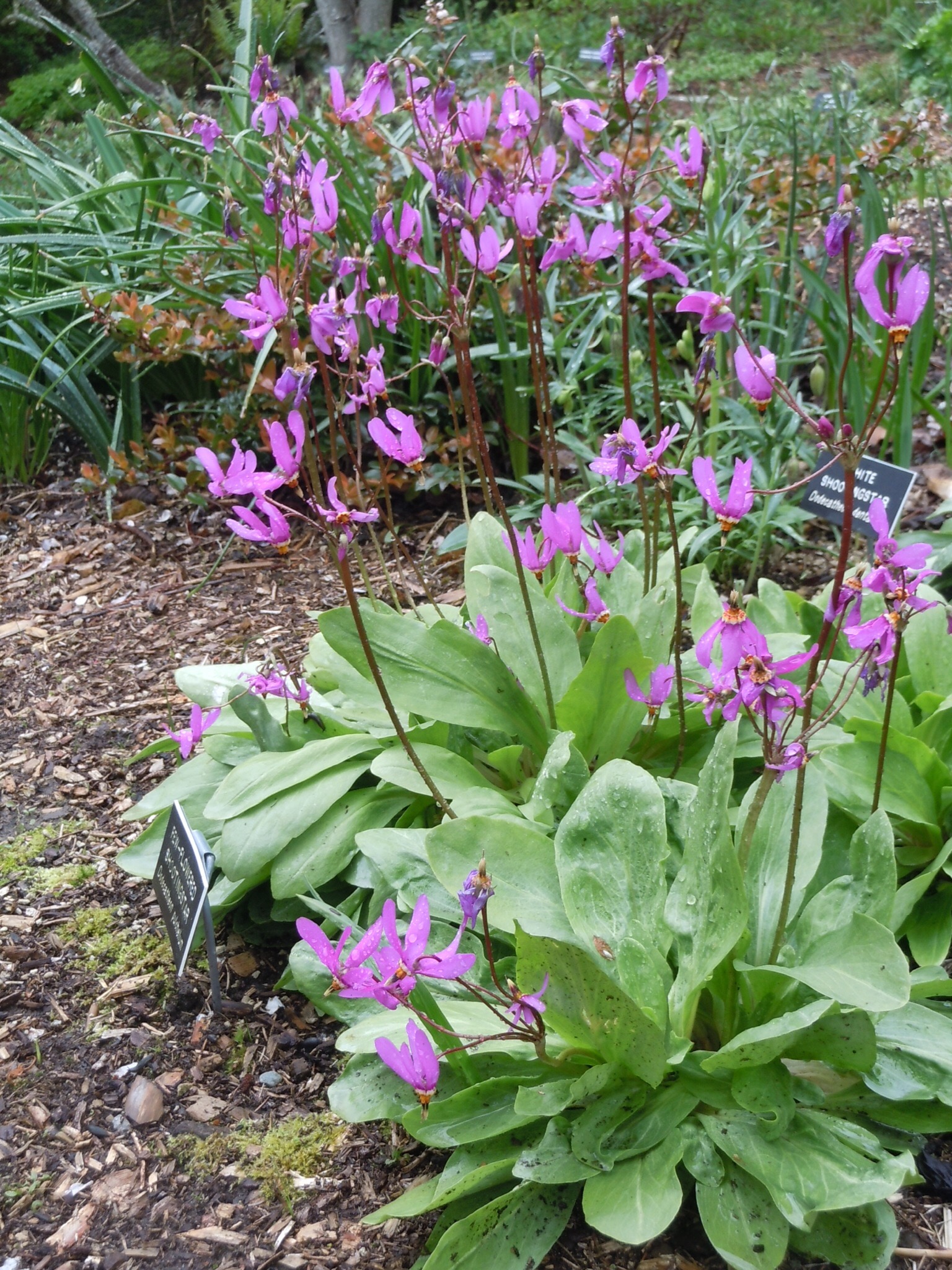
Shooting stars (pulchellum, or few flowered) are starting to come up this last week (feb ~10). They do NOT look like this yet, however!- at this point in time they have barely poked out of the ground. This is quite a late appearance compared to last year, when there were sightings of these in early January, about a month earlier. But then again, last year was way early. The appearance of some other plants is also relatively later, also, including the tritelliaea, Camas (light blue and white), Hookers onions. As far as seeds go, only the yellow Desert Parsley has germinated, but there is a big mound and some shoots showing, so there will undoubtedly be dozens or more of these! Others anticipated, especially Woodland Penstemon, Iris Chrysophylla, Indian Paintbrush and Pink Fawn lillies, all of which have so far been elusive. 

In review of the post from a year ago, I had found two barely live plants that had returned from the missing or dead, I’ll call them Lazarus the Rattlesnake plantain and Phoenix the Wild Ginger plant. Both are thriving now, despite their rough and slow starts. The Wild Ginger had been tortured by slugs, until I covered it with a cloche last year, the plantain I just kept uncovered by pine needles, and now nature has taken over. 

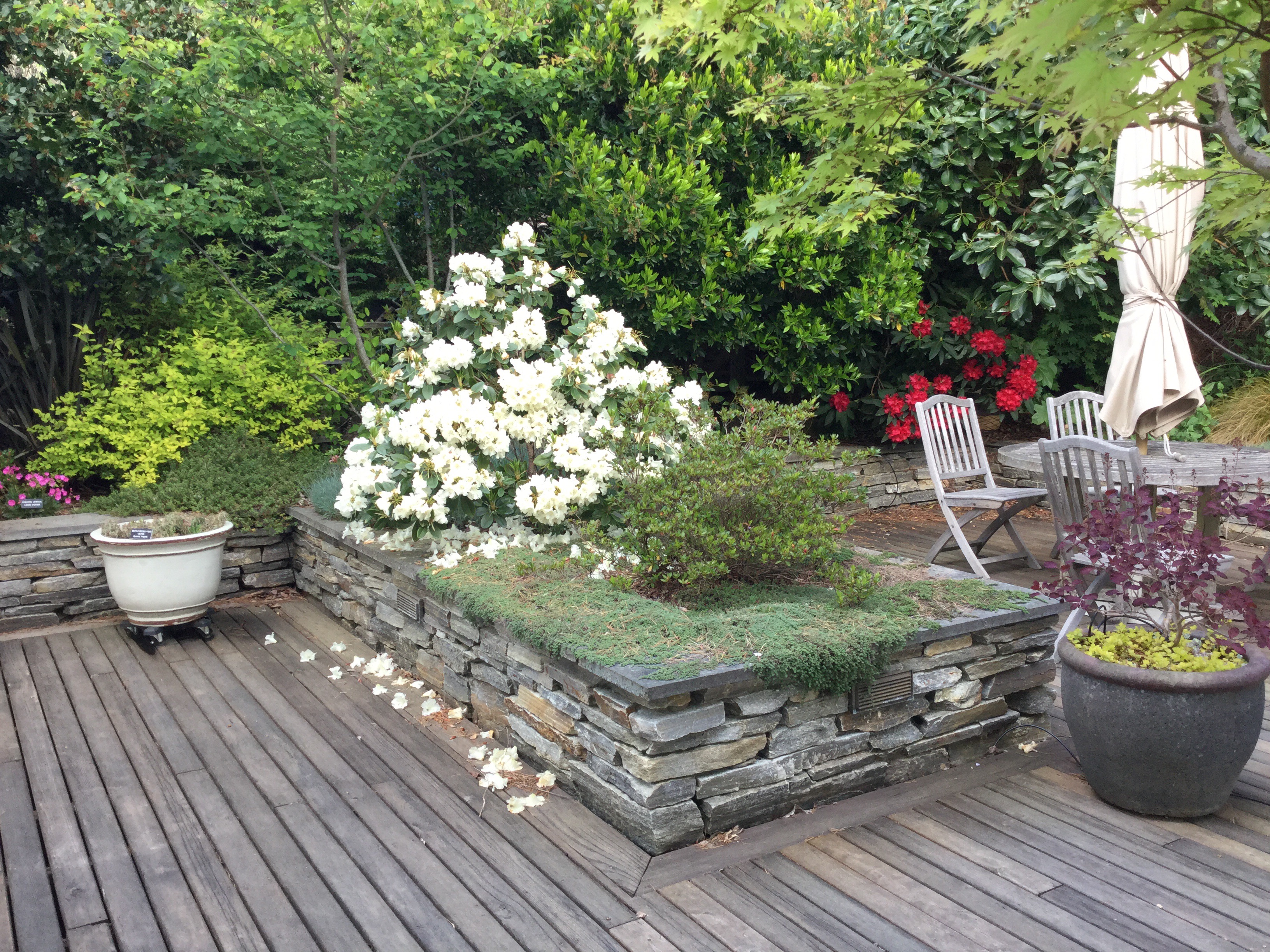
We are having a number of small trees taken out, which have outgrown their sites. Four of these are evergreen trees inside the raised planter bed, in the north backyard. These have gotten too large and compete wth each other for sun, each growing way out over the deck and making a mess as well as ending up distorted by each other. These were all deliberately planted years ago: a moderate size Madrona (litters large leaves onto the deck), a Strawberry tree (which leaves a nasty mess with mushy berries and flowers on the deck), and two tallish Bay leaf trees. I had already planted two Myrtle trees BEHIND the raised planted bed, which are each about 6-7 feet tall now but are not getting enough sun, leaning over and with wimpy branches. Taking these four trees out will give the Myrtles lots of sun and they should fill in the screen border (I may throw a viburnum in between for good measure). Unfortunately there will be a paucity of screen in the meantime, so we’ll have to use the umbrella a lot. Fortunately though, the row of Myrtles, Viburnums, and Strawberry trees along this same border nearer the house have matured and near completely screen out the neighbors. This is more of a continuation of the same screen row pushed out of the yard, to reclaim the raised bed space. I’ll have to do a. It of  LITTER cleaning once the trees are out, since the area under those trees is thick with leaves, small branches and pine needles. This is a pic from a several years ago looking at several of those trees (towards the right, around the red rhodie), they had already filled in the planter space:

Several other trees will be taken out here and there. This also includes several NON-NATIVE American Cranberrys, which turned out to be the European variety, and there were three that we need out (the fourth, which has grown almost as a trellis over the stream, will be kept). We found a true Native American Cranberry which will be planted. And some lowering of Vine Maples and pruning of some Pine branches. 

February news

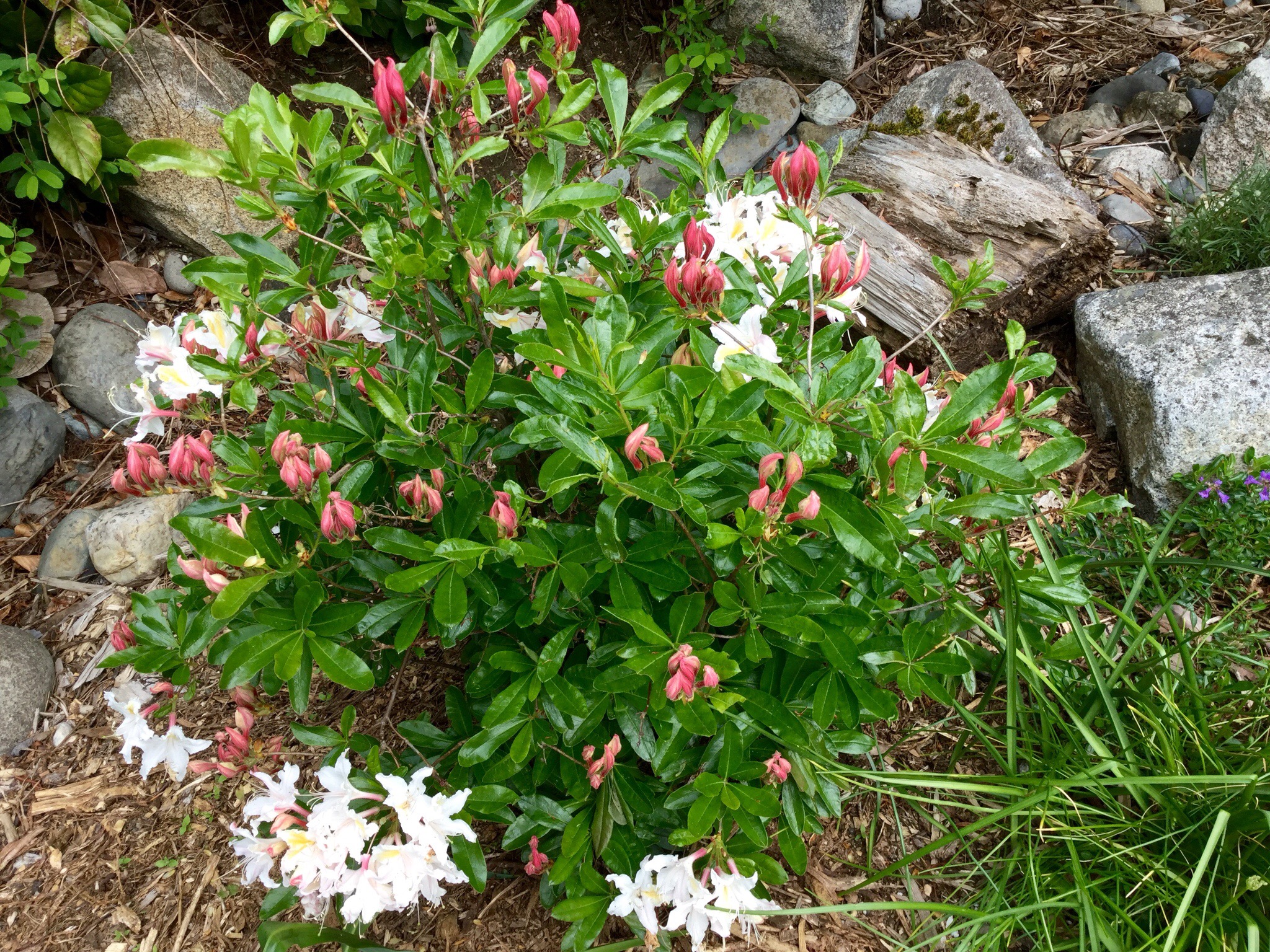
Last week of January the White Tritellia and  Delphinium came out (Harvest brodiaeas and camass previously). This past  week it was the beginnings of the Shooting star,  Ookow, and Brodiaea Congesta showing up.  Budding starting on the red flowering currents and of course the Indian Plums, which should actually bloom soon. It looks like the two layerings of Deciduous Rhodies in the front have made it through the winter and will produce small bushes on either side of the gravel path ( update 10/17, the dominant one is doing great with mult. New branches the one with tenuous roots did OK for a while and then died out in the heat. These are pretty peach colored flowers which are scented.

Winter shelter for the birds

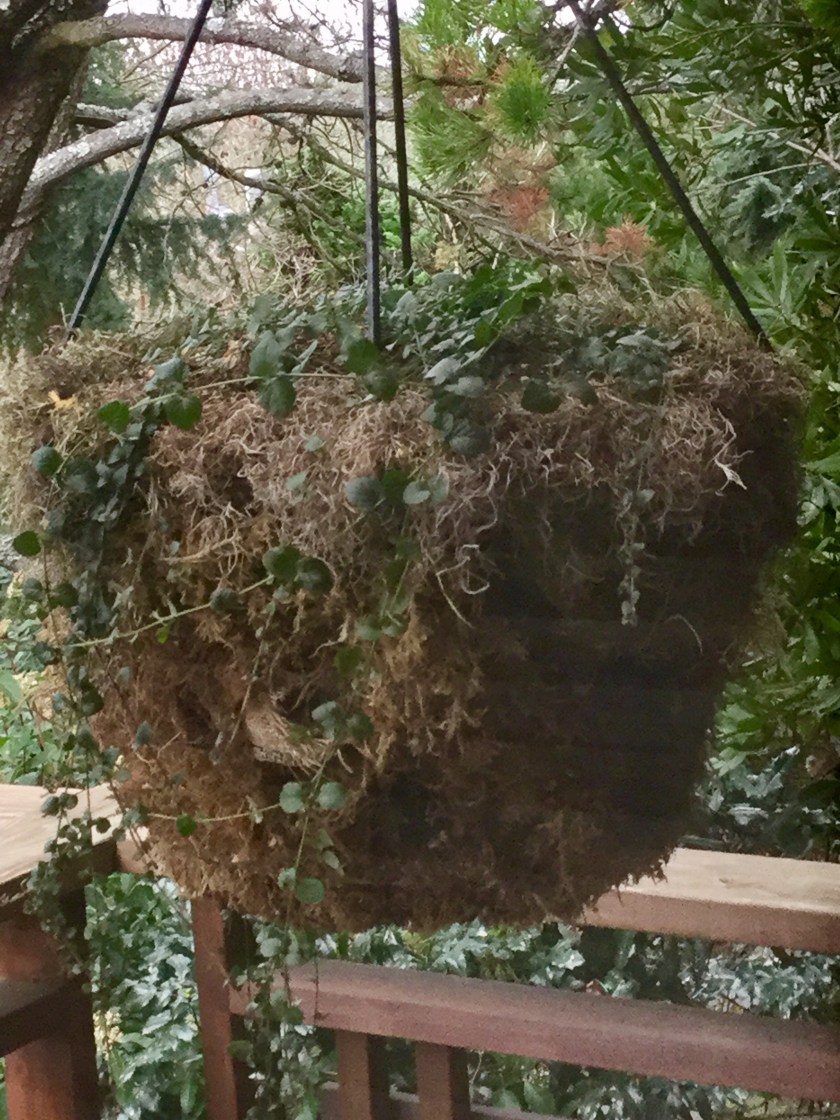
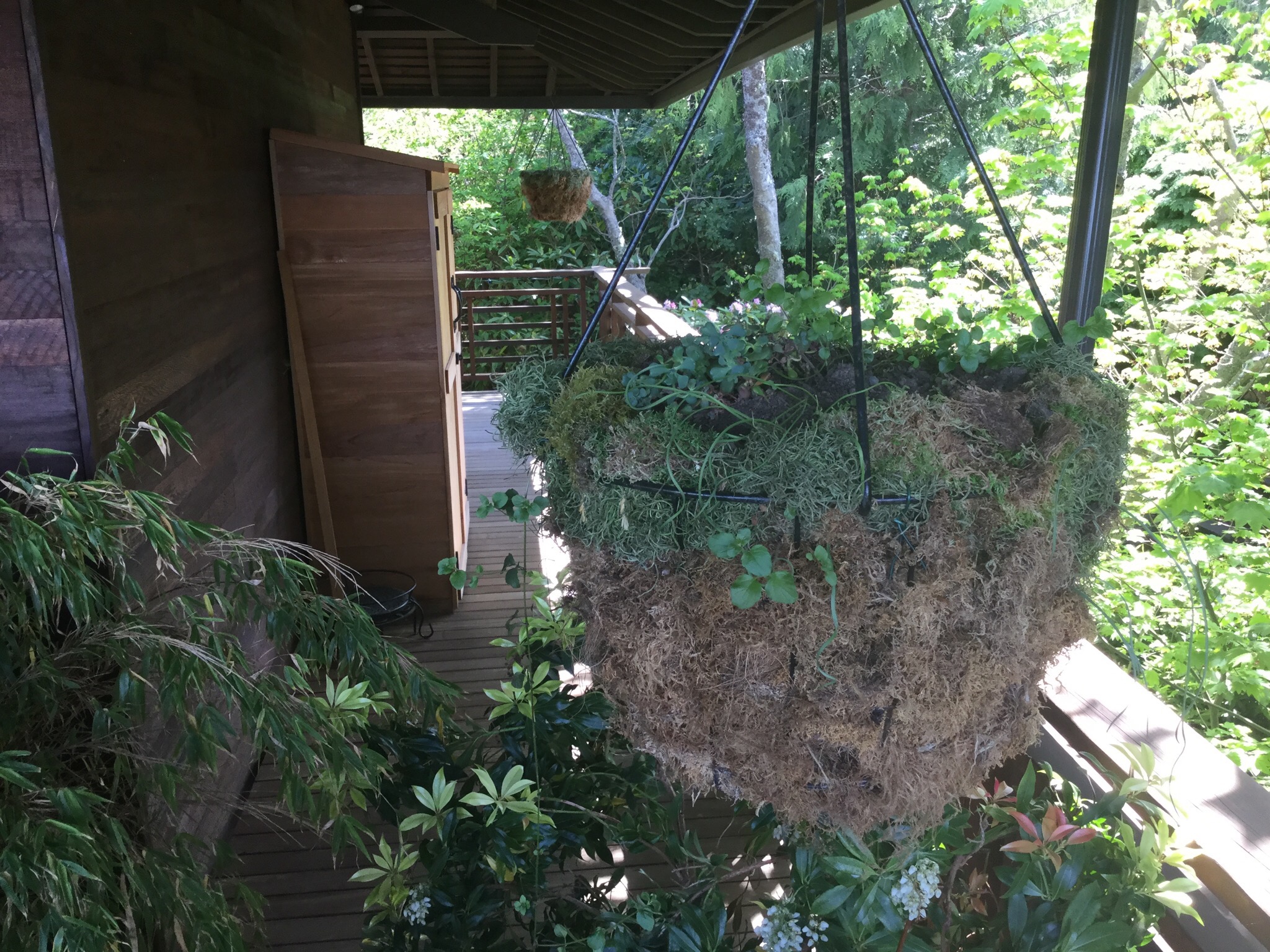
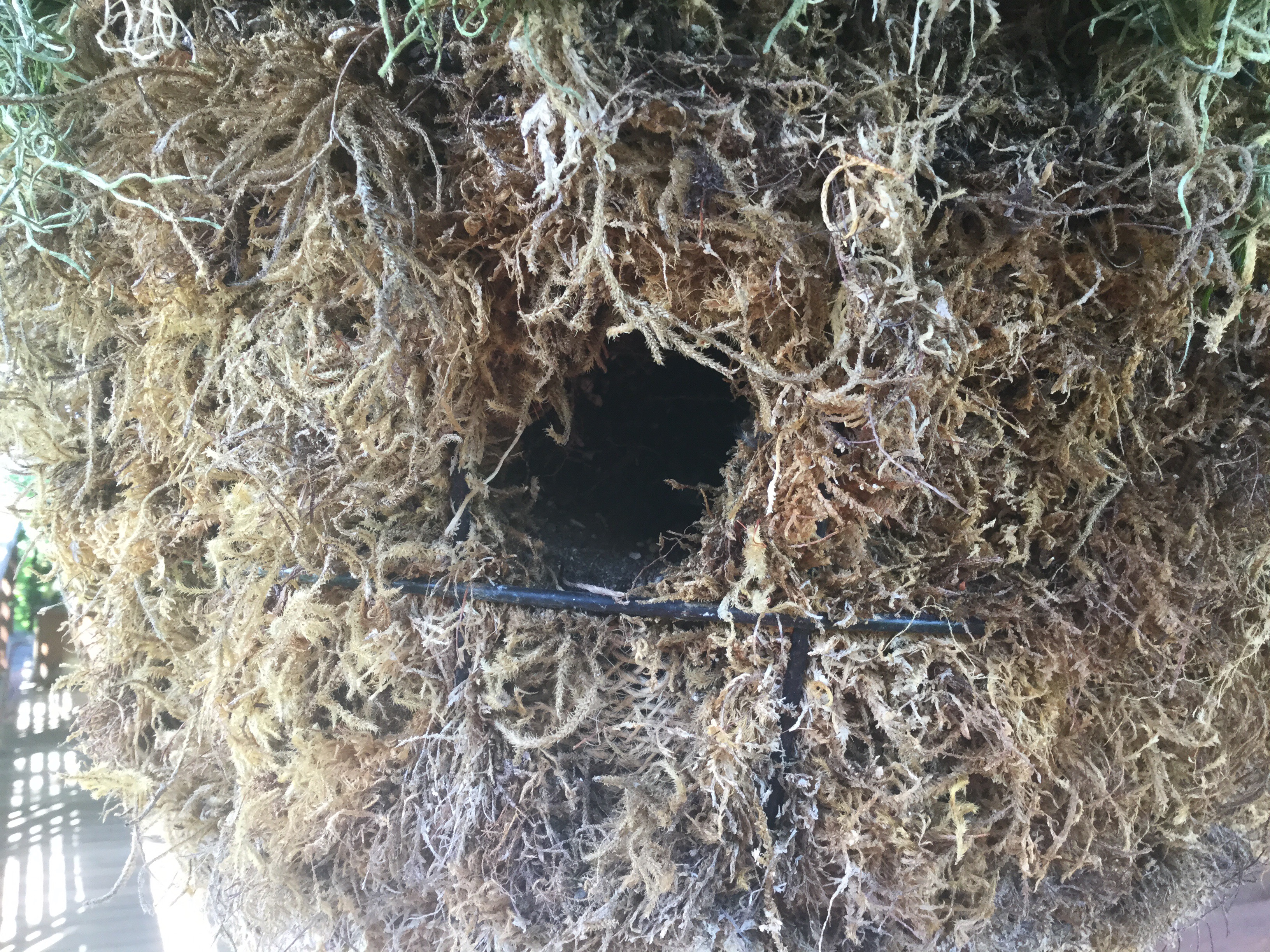
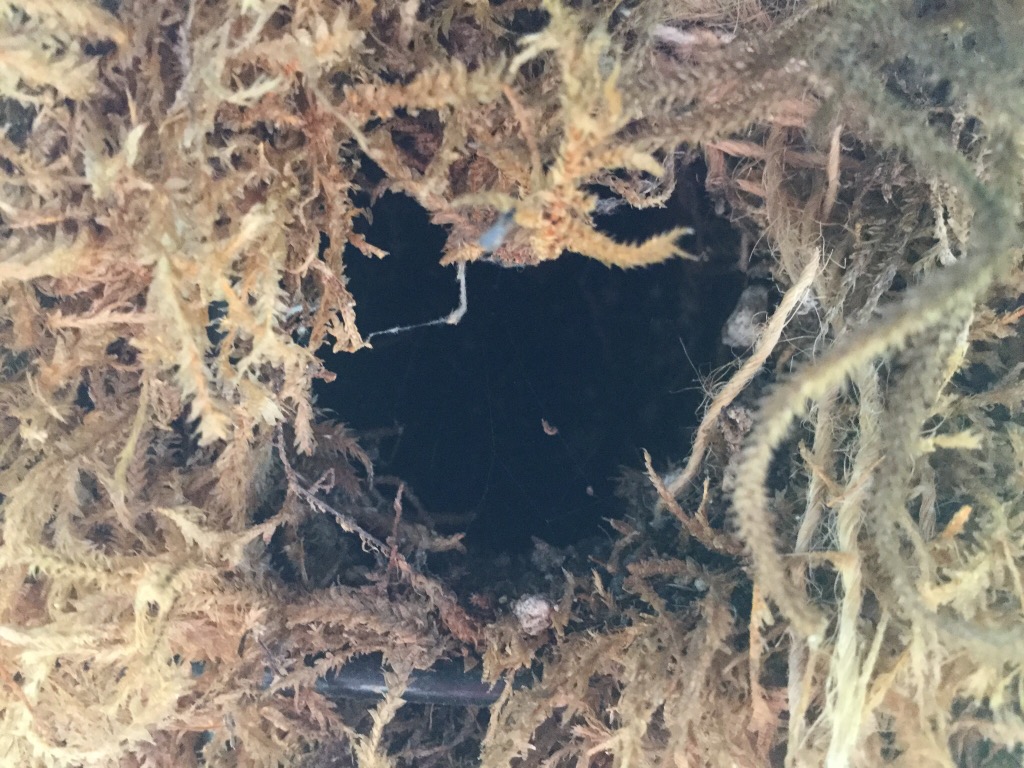
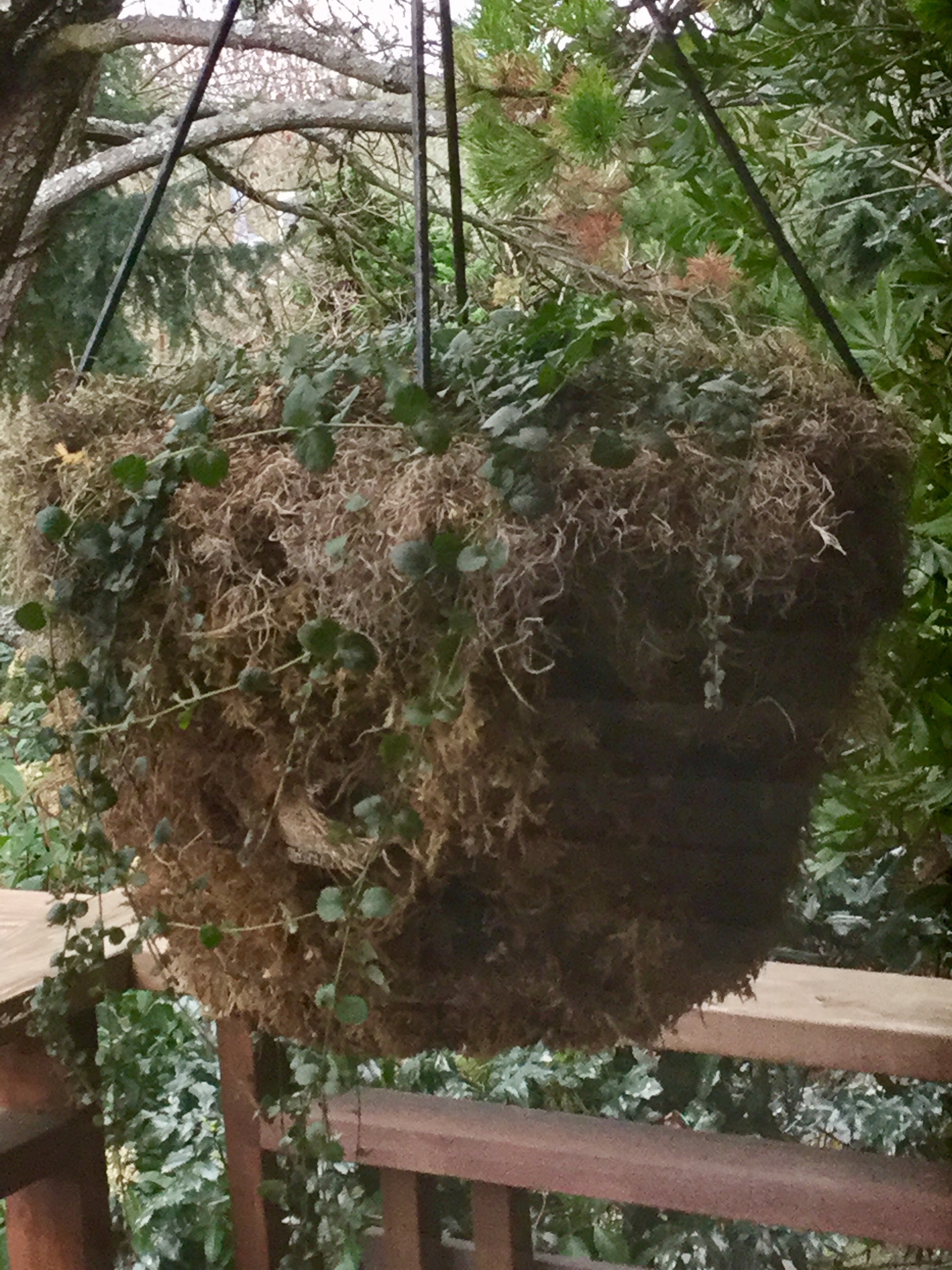
At least the wrens and maybe chickadees. The wrens have long commandeered our three hanging baskets for their hostels to sleep in overnight, except for when they are nesting. These are perfect shelter in that they hang just under the roof of the covered deck, and are heavy so they don’t swing in wind. Being within deck territory, they are predator-free. There are 3-6 holes in each which are about 1 1/2 ” wide  x  3-5″ deep, horizontally oriented into the planters, dug through the moss,  burlap and soil in the planter, to make individual little lofts. A couple are a little bigger, maybe they hold three or so. 

I recently rehabbed these planters specifically for the wrens, and shored them up with new moss and burlap but made sure to avoid damaging the wren holes. I added garlands of Spanish moss wired along the rim, topped them each with extra soil and sand, and planted Yerba Buena vines, which grow better than most things there. When I water the plants, the water seems diverted around the wren holes, so they might be sealing them.  Below are pix:

Now I’ve made a more formal abode for any leftover wrens that haven’t found a hole. I know there are a bunch of wrens out there but I don’t know where they all roost. It’s freezing weather off and on (now on) the last week or so, so I thought I’d provide some extra emergency shelter for them.  

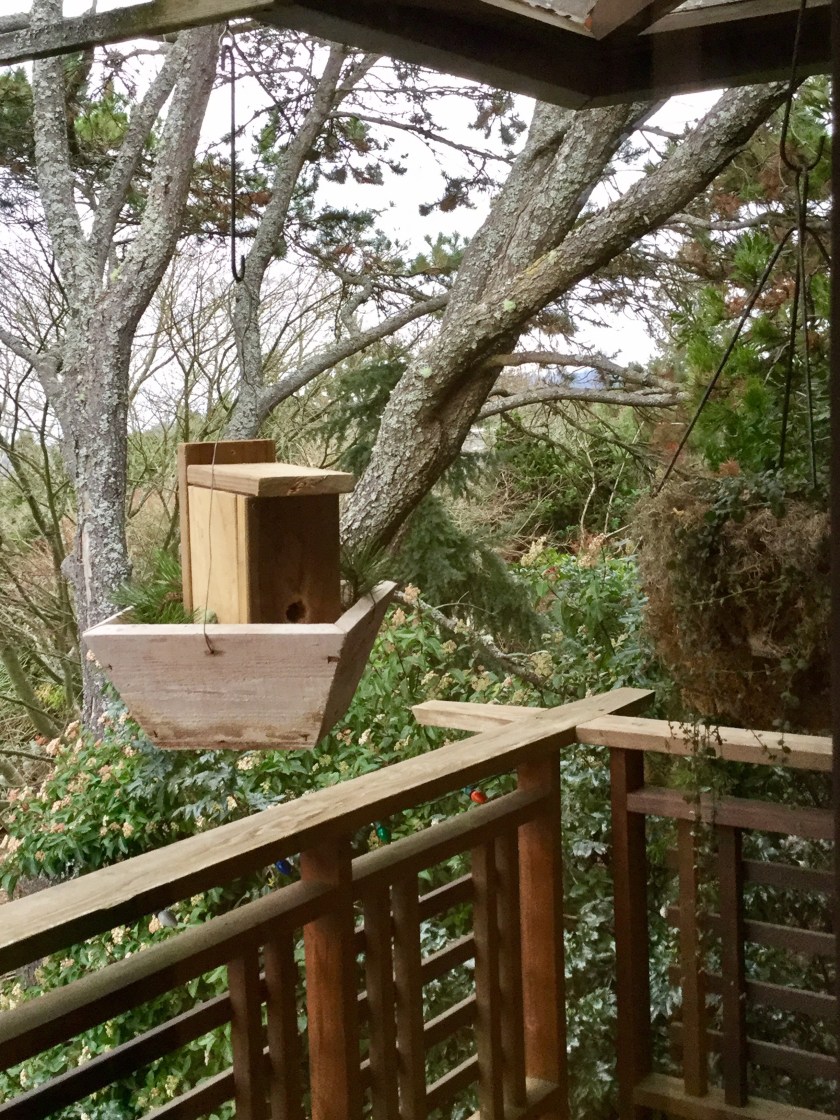
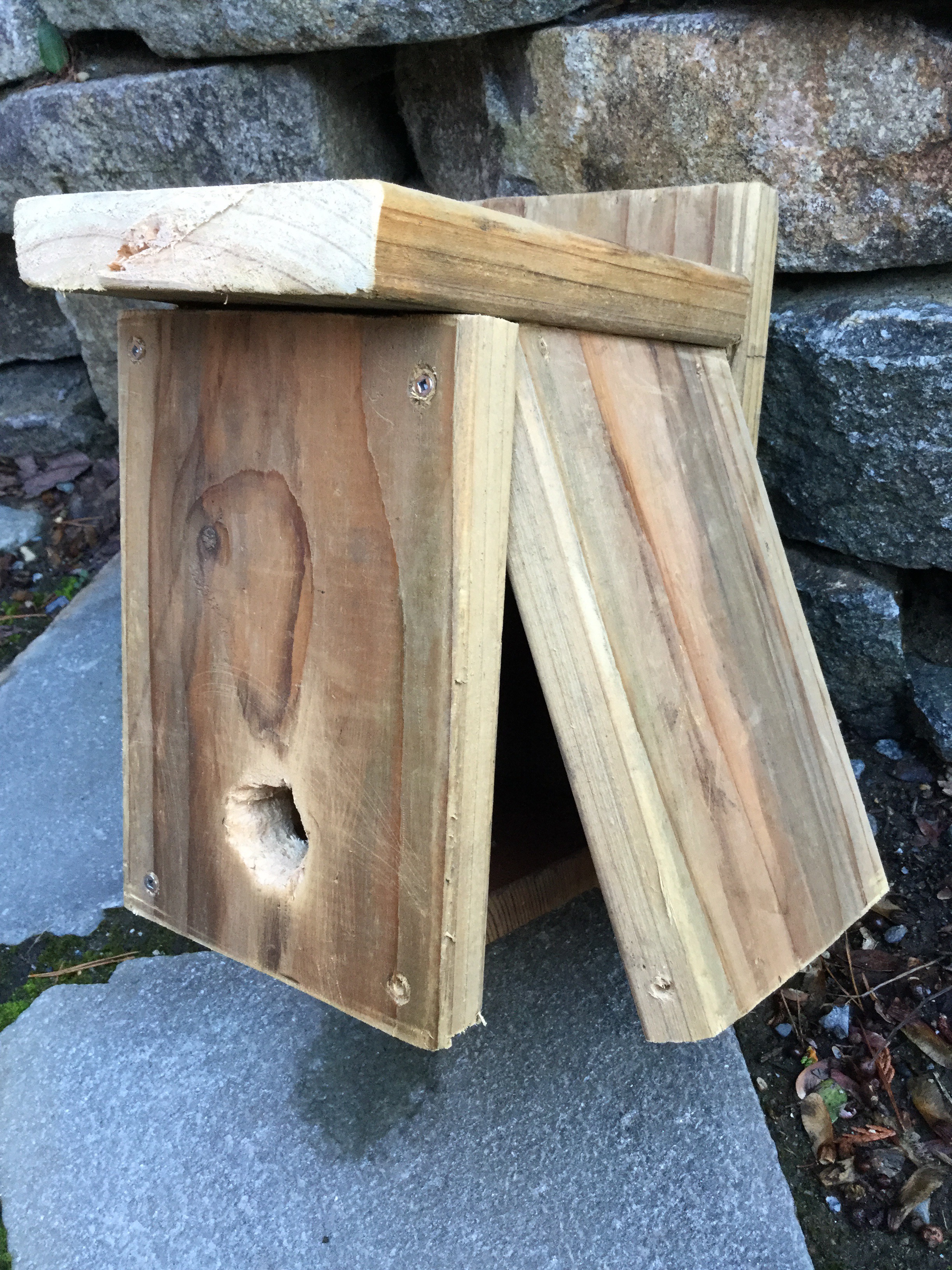
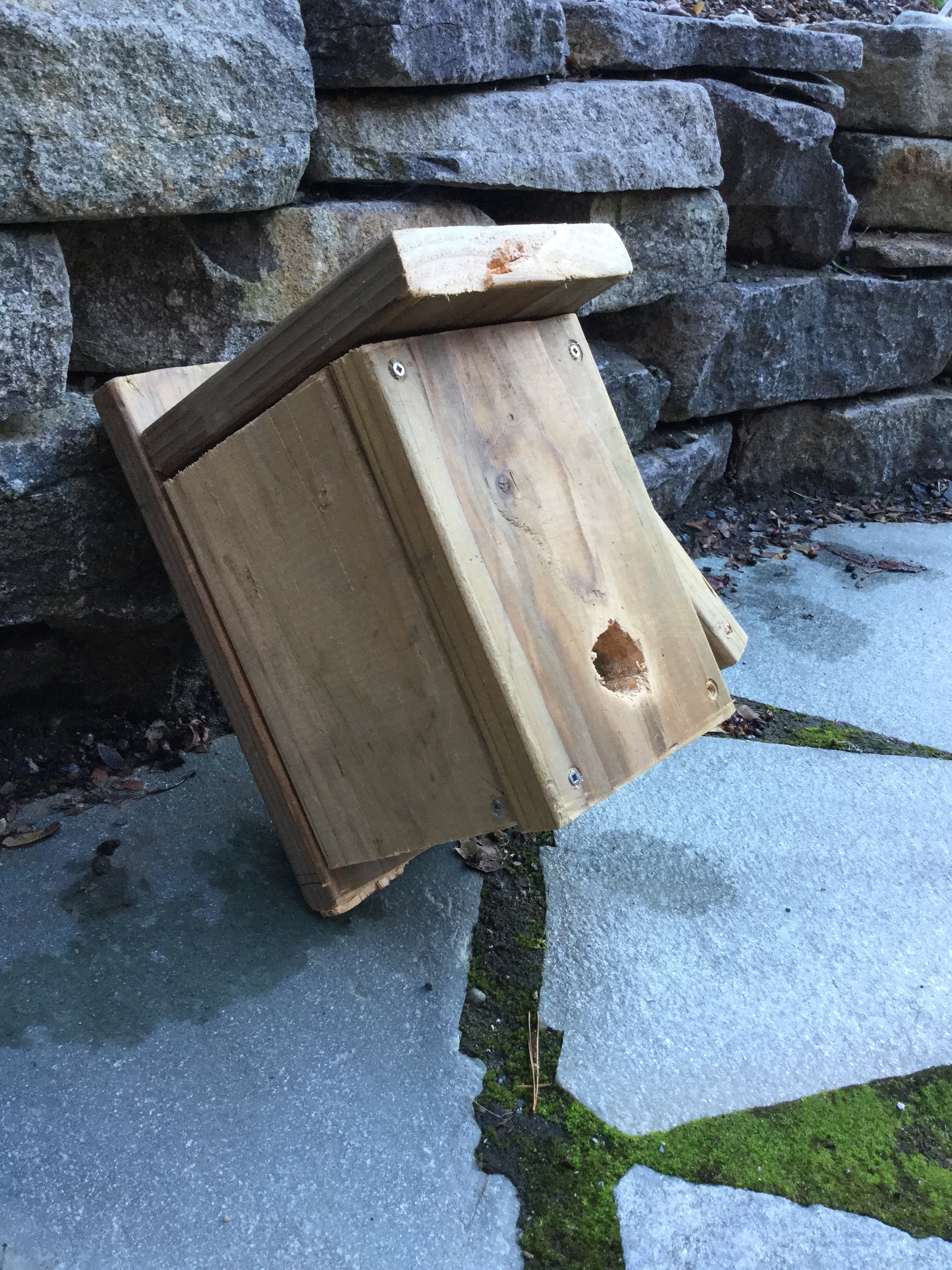
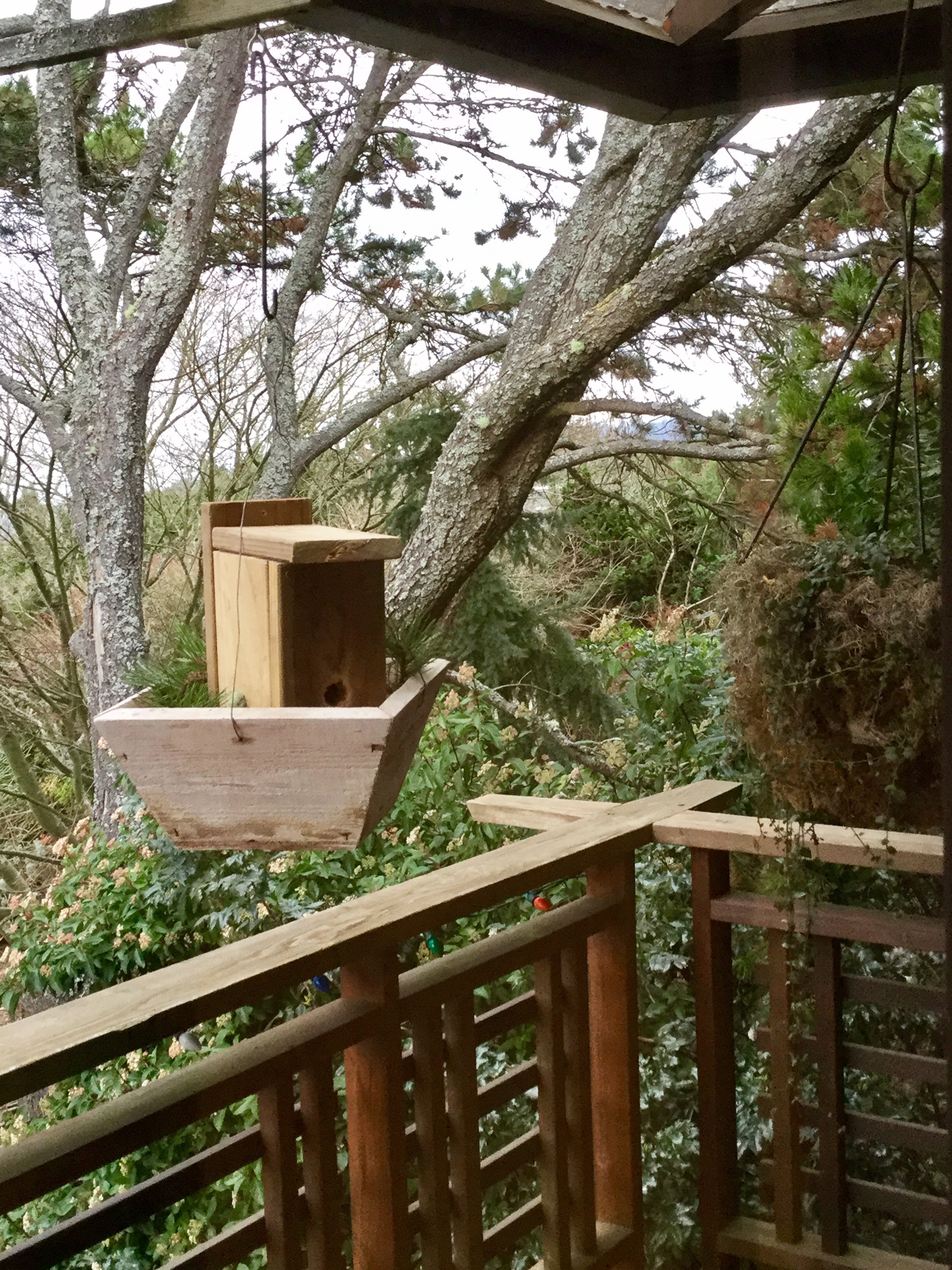
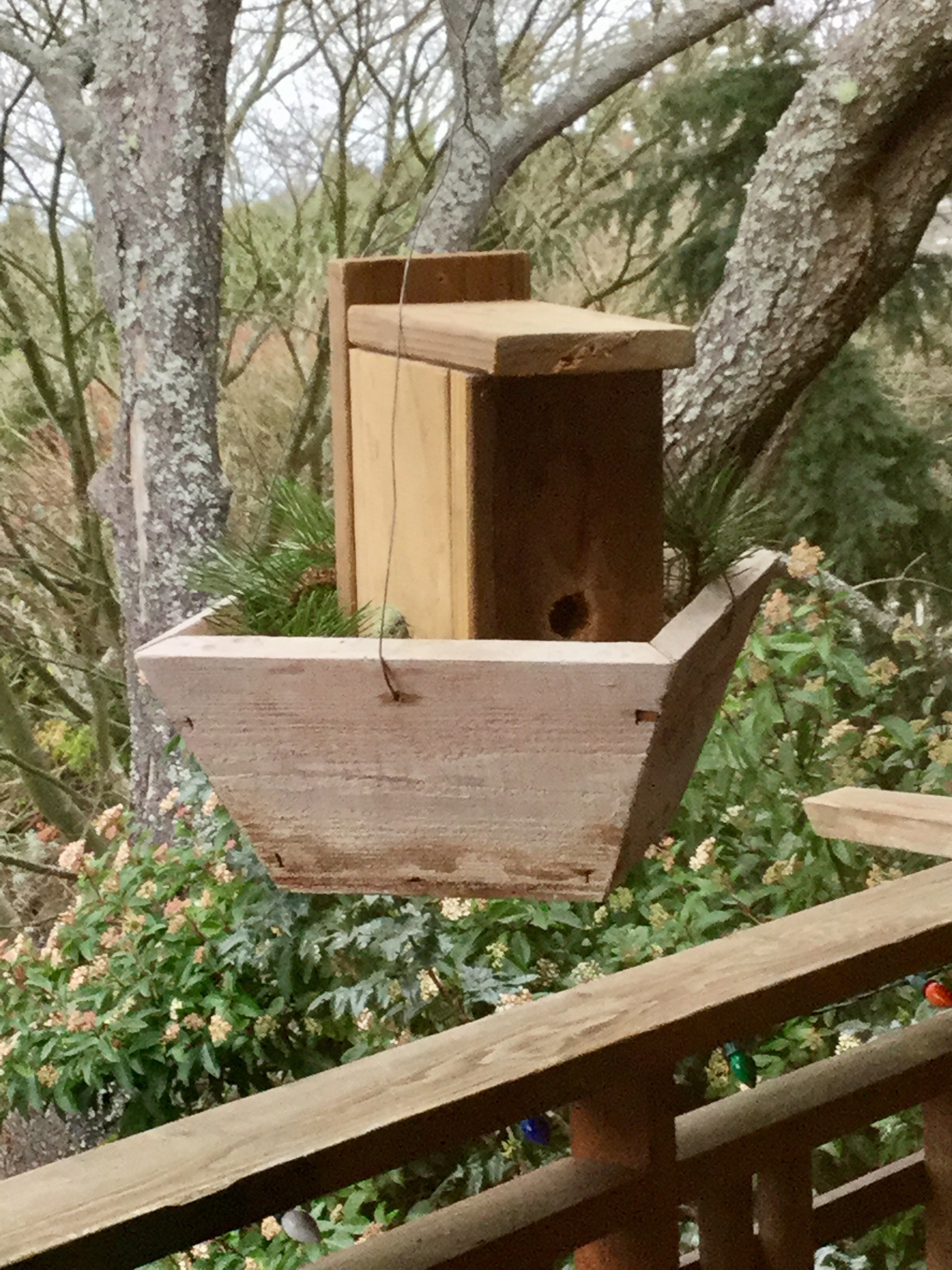
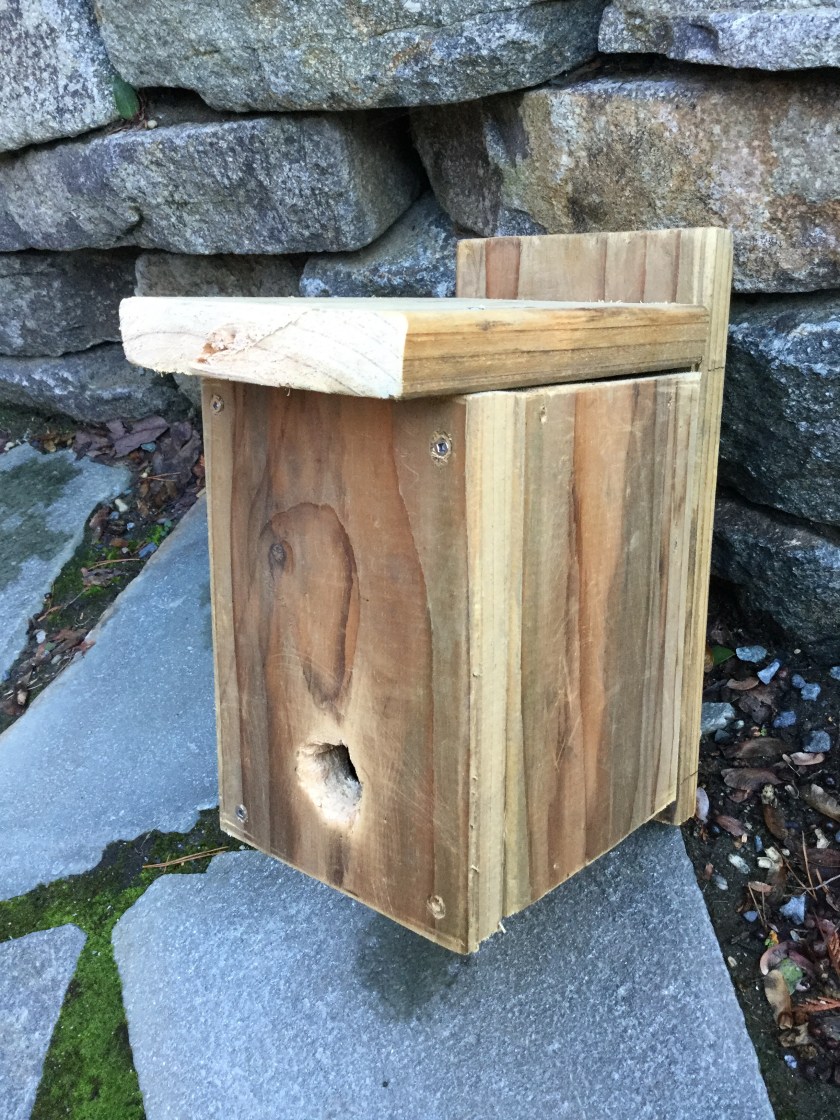
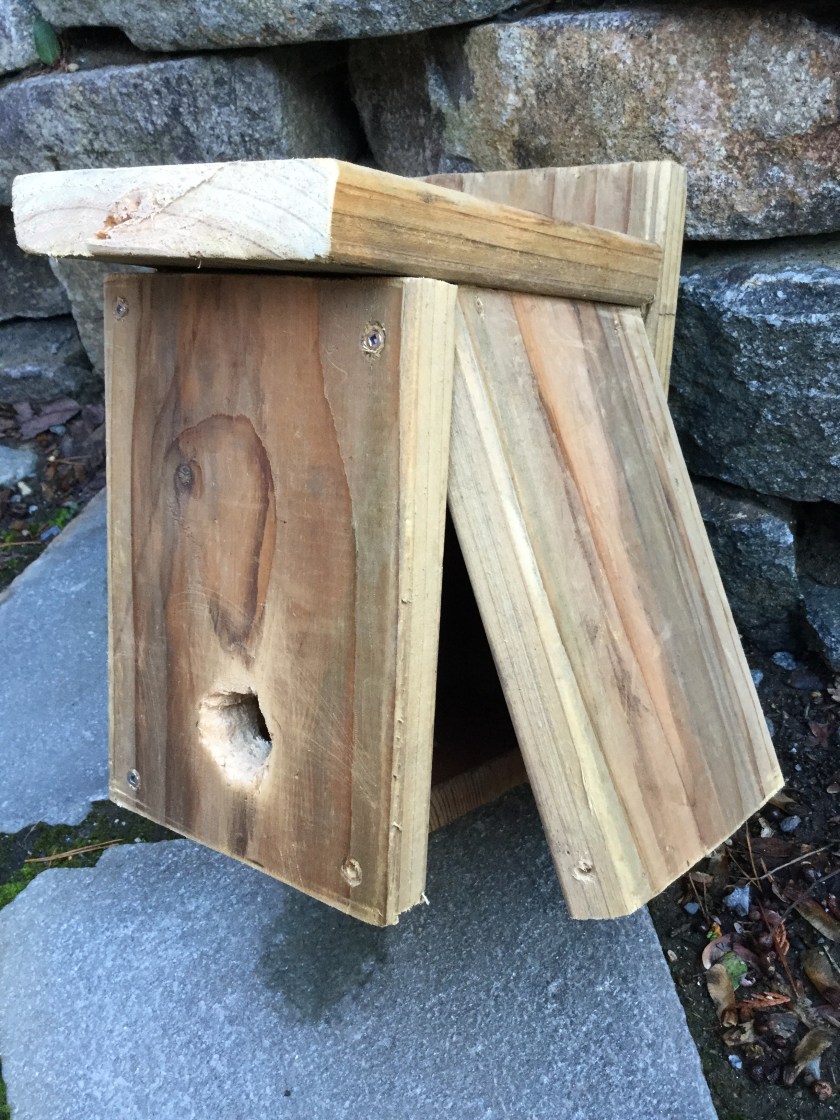
So I made a ROOSTING BOX for the wrens, wth provisions for possible chickadee use. The specs for these birds are 1 inch thick walls, 4 x 5 1/2 inches base by 8 inch height, with overhanging roof.  One of the side panels swings out a bit for cleaning, secured during use by birds. Right now, I left it unsecured so I can figure this out. Roosting and nesting needs are different, so there is a twice a year clean out and modification for nesting purposes.

For Roosting:

1.the hole for bird entry should be towards the bottom, so that the rising heat generated by the congregation of shivering birds doesn’t just go out a hole at the top. Some bird types can lose up to 10% of their weight overnight from keeping warm in very cold climates.

2. Some sites advise adding pegs/dowels for perching, but other sites say that wrens and chickdees don’t need perches and that they are detrimental by encouraging their competitors. The birds sleep on the floor, and on each other as they add up. Apparently the largest number of wrens observed coming out of a bird box was 31, presumably from a larger house than mine.

3. You can add wood shavings, grass, or other material, as long as it doesn’t risk obstructing the hole and trap birds.  Short yard pieces or animal hair and fur are recommended. There are some who convert bird feeders to nesting/roosting material dispensers, and in fact these are now available commercially.  I put short thin strips of old t shirt to just cover the botttom. 

4.The hole size of 1 inch will limit admission to wrens. A hole size of 1.125 inches will also allow chickadees, but not destructive house wrens, sparrows or other competitors. 

5.No perch on the outside either, to limit larger competitors. 

6. Wrens don’t mind a hanging house (hey, they made themselves at home at each of my three hanging baskets), but chickadees and other birds do.  I don’t know what it means if the house is hanging but very stationary. I ended up using a shallow old hanging basket which was empty except for some dirt to use as a hanging device, so the bird house is sitting in it.

For Nesting:  the hole should be towards the top, to allow the nest and eggs/young to be protected from predators, and it also allows better ventilation of heat during the warm months. This can be accomplished easily by removing the screws on the front panel and inverting the panel for the season during cleaning. Also add several floor drainaing holes and few top ventilation drill holes, all of which are covered over during the winter (done).

 I placed the box on top of the dirt and used the planter box as a device to hang up the Roosting Box in a stable protected environment. In fact, it is about 3 feet away from the northwest hanging basket, a site they chose on their own. The new box is hanging from a wooden attachment to the overhang, then two wire hanging parts that I hope will help keep the rats out. I won’t have any food there and they won’t nest there. So, wrens, it has been hanging there 36 hours, time to wake up! I know you are out there cuz I saw you….!.
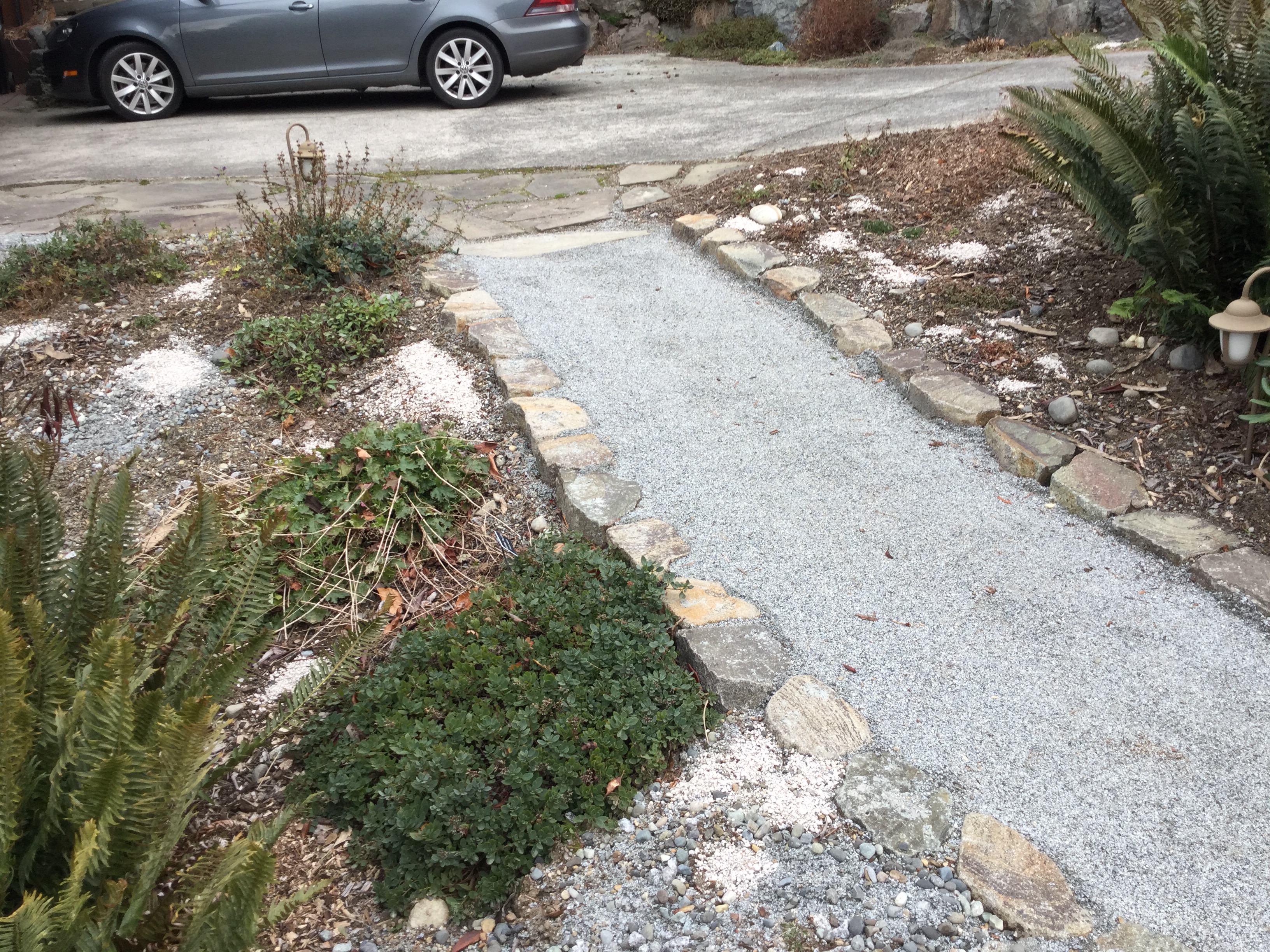
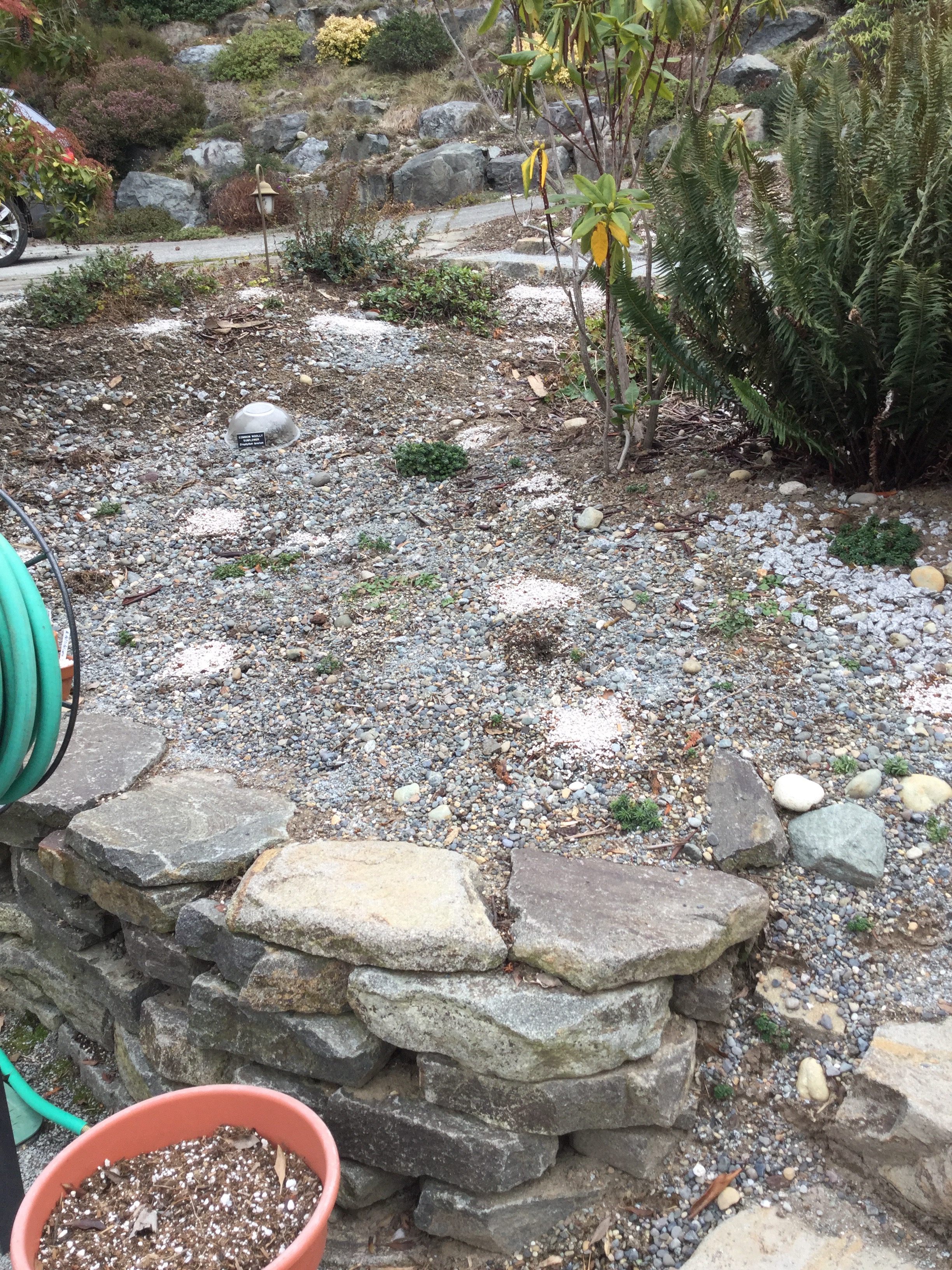
Plants poking up only include the usual, the light blue camas and the brodiaea. Few trilliums are also just visible, but they usually don’t do much for months. Lots and lots of patches of Pumice, which I placed on top of every small patch of seeds or bulbs that I put Everywhere:
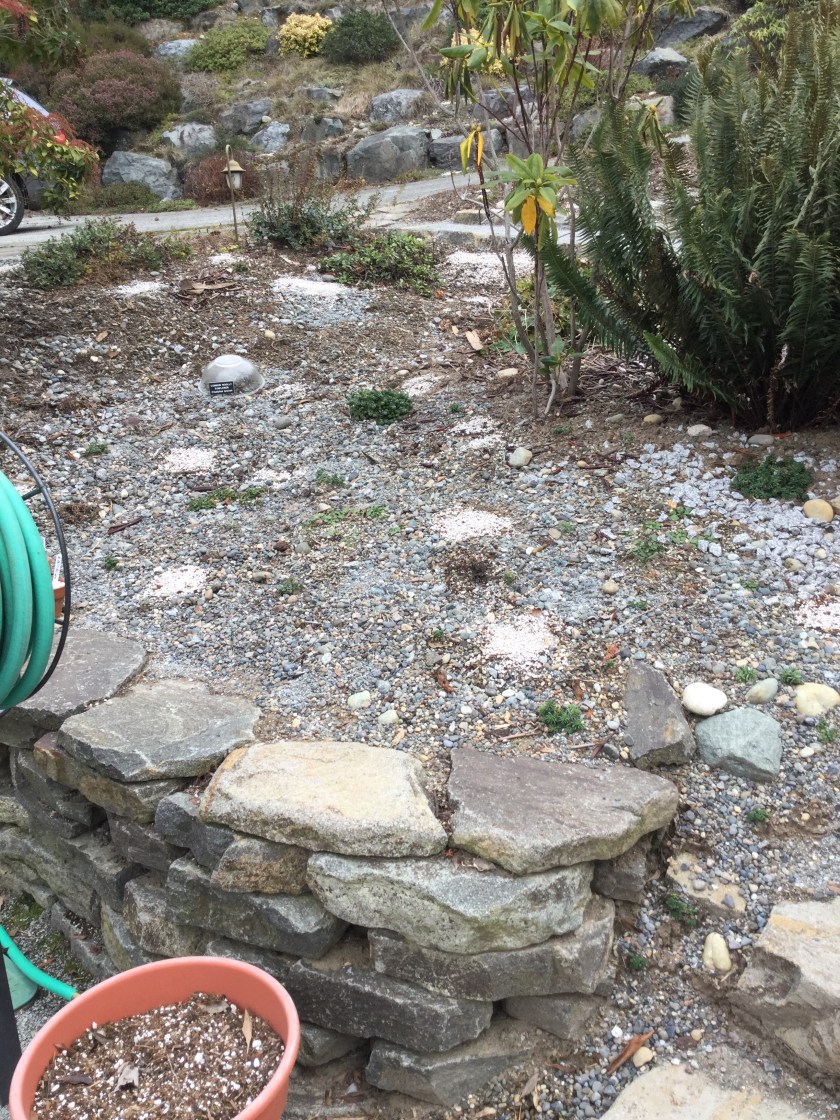
Plants poking up only include the usual, the light blue camas and the brodiaea. Few trilliums are also just visible, but they usually don’t do much for months. Lots and lots of patches of Pumice, which I placed on top of every small patch of seeds or bulbs that I put Everywhere

 I also transplanted the old patch of Spotted Saxifrage, which has been moved several times. It is now one of the first plants put in the new front yard rock garden, trying to supply it with the right amount of sand/grit and soil, sun but not too much. It is a great plant but it got shaded out and overwhelmed by Twinflower Linnea, and there is only one other 2″ patch remaining in the back yard, and so this needs to work!